A 10% spike in retail demand can turn into a 40% surge in raw material orders by the time that signal reaches the factory floor. That amplification is the bullwhip effect, and it costs companies between 25% and 40% more in inventory carrying costs every year, according to research published in Management Science. In 2025, with US tariff policy creating a new category of artificial demand shock on top of an already noisy signal, the problem is getting worse for companies at every scale.
AI demand planning is changing that calculus. By replacing lag-based forecasting with real-time pattern recognition across hundreds of input variables, AI attacks the bullwhip at its structural causes rather than reacting to its symptoms after the damage is done. Here is what peer-reviewed research shows, how each mechanism works in practice, and what companies across retail, food manufacturing, and industrial distribution are actually getting out of it.
What the Bullwhip Effect Actually Costs Supply Chains
The bullwhip effect gets its name from physics. A small flick of the wrist at the handle of a bullwhip produces a massive crack at the tip. In supply chains, the consumer is the handle and the raw material supplier is the tip. A small, temporary demand shift at retail gets interpreted, re-ordered, and re-interpreted at each upstream stage, amplifying into massive swings in inventory and production that nobody at the retail end intended or predicted.
This is not a theoretical concern. In 2024, excess stock grew to 38% of total inventory among small and mid-sized businesses, with companies over 500 employees seeing that figure reach 44% of total inventory value, according to Netstock’s 2024 inventory benchmarks. Roughly 55% of SMBs reported holding at least 20% excess inventory. The cost of that excess is not just the carrying charge. It is the capital locked out of other parts of the business, the warehouse space consumed, and the markdowns required when the inventory ages out.
Eliminating or significantly reducing the bullwhip effect can increase profits by an average of 15% to 30%, according to analysis published in the MIT Sloan Management Review. That range is wide because the impact depends heavily on supply chain complexity and how severe the bullwhip distortion currently is. But for most mid-market and enterprise supply chains running on traditional planning methods, it represents a substantial and largely uncaptured opportunity.
How Amplification Builds at Each Tier
The mechanics are straightforward even if the consequences are not. A retailer sees sales of a product jump 10% for two weeks during a promotion. Uncertain whether this reflects a permanent demand shift, the retailer orders 20% more from its distributor to be safe. The distributor, seeing a 20% order increase, orders 35% more from the manufacturer. The manufacturer, now seeing a 35% demand spike, ramps production and orders 50% more raw materials from suppliers.
When the promotion ends and retail demand returns to baseline, the same amplification runs in reverse. Cancellations cascade upstream, leaving every tier holding excess inventory it does not need. The original demand signal was noise. The supply chain response was real and expensive.
The Four Root Causes and Why They Are Hard to Break Without AI
MIT Sloan’s original bullwhip research identified four structural causes, all of which remain active in most supply chains today:
- Demand signal processing errors: Each supply chain tier forecasts based on orders it receives rather than actual consumer sales data. Errors compound at every handoff. The distributor is not forecasting consumer demand. It is forecasting what the retailer will order next, which is already a distorted version of the consumer signal.
- Order batching: Companies consolidate orders weekly or monthly to reduce transaction costs. This creates artificial demand spikes that look like genuine surges to the tier above. A supplier receiving three months of consolidated demand in one order cannot distinguish that from a real demand event.
- Price fluctuations and promotions: Temporary discounts drive forward-buying by retailers, who stock up at the promotion price. This sends a false abundance signal to manufacturers, who ramp production based on what turns out to be a one-time buying event rather than a structural demand increase.
- Rationing behavior: When supply is constrained, buyers order more than they need as a hedge, knowing their order may be cut. This is rational at the individual company level and catastrophic at the system level. Every buyer hedging simultaneously turns a moderate shortage into a demand spike that triggers even more production.
AI demand planning is uniquely structured to address all four causes directly, rather than managing around them.
Why Traditional Demand Planning Feeds the Cycle
Roughly 75% of supply chain executives still rely on manual planning methods, primarily spreadsheets, according to McKinsey Global Institute research. That statistic is striking given how much has changed in supply chain complexity over the past decade, but it reflects the organizational inertia that surrounds planning systems in most companies.
Spreadsheet-based forecasting has three structural problems that feed directly into bullwhip dynamics.
The Spreadsheet Problem
Historical sales data tells you what happened. It cannot tell you what is changing. When demand shifts because of a weather event, a competitor’s stockout, a viral social media moment, or a macroeconomic development, a model built on historical averages will miss the signal entirely until enough new sales data accumulates to shift the trend line. In practice, that means the lag between a real demand shift and a planning response is measured in weeks, not hours.
That latency is the single biggest driver of bullwhip amplification. By the time the traditional planning model detects a demand shift and generates a new order recommendation, the supply chain has already been operating on the wrong signal for weeks. The correction that follows is always larger than it would have been with a faster, more accurate initial response.
Batch Ordering and Artificial Demand Spikes
Traditional planning systems also reinforce batch ordering behavior because they are designed around fixed review cycles. If the system generates purchasing recommendations weekly, buyers naturally consolidate orders to align with that cycle. The result is the artificial demand spikes at the supplier level that are one of the four root causes of the bullwhip effect.
This is not a failure of individual planners. It is a structural artifact of planning systems that were designed for a world with slower communication, fewer SKUs, and less supply chain complexity. The world those systems were built for no longer exists.
How AI Demand Planning Attacks the Bullwhip at the Source
AI demand planning does not just improve forecast accuracy. It changes the structural dynamics of how demand signals travel through the supply chain. That structural change is what reduces the bullwhip effect at its root, rather than producing incremental accuracy gains on top of the same broken process.
Real Time Demand Sensing vs. Lag-Based Forecasting
Traditional forecasting is reactive. A retailer records a demand spike, the signal works its way upstream over days or weeks, and each tier responds based on a signal that is already stale by the time it arrives. AI demand sensing reverses that flow by pulling from point-of-sale data, weather forecasts, foot traffic analytics, social signals,promotional calendars, and macroeconomic indicators in real time.
This eliminates the multi-week latency that is the primary driver of bullwhip amplification. One case study documented by Firstshift AI showed that integrating POS data and localized weather patterns reduced forecast error by 25%, which subsequently cut safety stock requirements by 15% and flattened the bullwhip effect through seasonal transitions. The improvement was not from a better algorithm applied to the same stale data. It was from eliminating the lag between event and response.
Machine Learning Pattern Recognition LSTM, XG Boost, and Hybrid Models
Where traditional models use five to ten input variables, modern AI demand planning platforms use hundreds simultaneously. Three model architectures have shown the strongest documented performance for bullwhip reduction:
Long Short-Term Memory (LSTM) neural networks: are designed to capture sequential patterns in time-series data. They can learn that a specific sequence of weather events, combined with a promotional calendar pattern, reliably produces a demand spike in a particular product category three weeks later. Traditional models cannot learn these multi-variable sequential relationships.
Gradient Boosting models (XG Boost and Light GBM): are ensemble methods that combine hundreds of simpler decision trees into a highly accurate prediction engine. They are particularly effective at handling tabular data with many input features and tend to outperform simpler models when demand drivers are heterogeneous across SKUs.
Hybrid deep learning models: combine the sequential pattern recognition of LSTM with the feature-engineering strength of gradient boosting, achieving the highest documented accuracy improvements in recent research.
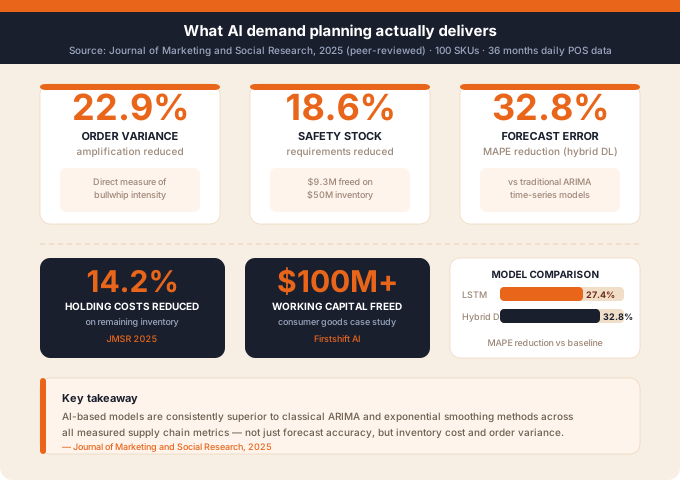
A 2025 peer-reviewed study published in the Journal of Marketing and Social Research tested these models against 36 months of daily POS data across 100 SKUs in three distribution centers, incorporating point-of-sale transactions, promotional schedules, lead times, weather indices, and Google Trends proxies as inputs. The results were specific:
- LSTM models reduced Mean Absolute Percentage Error (MAPE) by 27.4% versus traditional time-series baselines
- Hybrid deep learning models achieved a 32.8% MAPE reduction
- Safety stock requirements fell by 18.6%
- Holding costs dropped by 14.2%
- Order variance amplification, the direct measure of bullwhip intensity, decreased by 22.9%
The study concluded that “AI-based models are always superior in comparison to classical time-series models like ARIMA and exponential smoothing,” a finding consistent with a growing body of research across supply chain contexts.
Automated Order Smoothing Removes Batch-Driven Spikes
Order batching is one of the four root causes of the bullwhip effect, and it is almost entirely a consequence of planning system design rather than business necessity. AI systems reduce batch-driven volatility by continuously optimizing order quantities and timing rather than following fixed weekly or monthly schedules.
When an AI system calculates that demand over the next 10 days justifies a small replenishment order today rather than a larger consolidated order next Friday, it places that smaller order automatically. The demand signal seen by the supplier begins to approximate actual consumer demand rather than a weekly batched approximation of it. This continuous, small-batch ordering is the mechanism by which AI directly attacks the second root cause of the bullwhip effect.
The Data AI Demand Planning Performance by the Numbers
| Metric | Traditional Forecasting | AI Demand Planning | Source |
| MAPE Reduction (LSTM) | Baseline | 27.4% lower | JMSR, 2025 |
| MAPE Reduction (Hybrid DL) | Baseline | 32.8% lower | JMSR, 2025 |
| Safety Stock Requirement | Baseline | 18.6% lower | JMSR, 2025 |
| Holding Costs | Baseline | 14.2% lower | JMSR, 2025 |
| Order Variance Amplification | Baseline | 22.9% lower | JMSR, 2025 |
| Forecast Error (seasonal, POS + weather) | Baseline | 25% lower | Firstshift AI case study |
| Inventory Capital (modernized planning) | Baseline | 5% lower | Firstshift AI case study |
Source: Journal of Marketing and Social Research, 2025 and Firstshift AI case study documentation
These numbers reflect controlled research environments and case study implementations. Real-world results vary based on data quality, integration depth, and SKU complexity. But they establish a credible performance floor for what well-implemented AI demand planning delivers on bullwhip reduction.
What Those Numbers Mean in Dollar Terms
The 22.9% reduction in order variance amplification and 18.6% drop in safety stock are not just operational metrics. They translate directly into working capital.
Consider a manufacturer carrying $50 million in average inventory. An 18.6% reduction in safety stock requirements frees approximately $9.3 million in capital previously tied up in buffer stock. Add the 14.2% reduction in holding costs on the remaining inventory, and the financial impact is substantial before a single additional unit is sold.
One consumer goods company cited by Firstshift AI that modernized its planning ecosystem reported unlocking over $100 million in working capital through a combination of 8% improved forecast accuracy and 5% inventory capital reduction. The payback on the AI planning investment was measured in months, not years.
The McKinsey research on supply chain planning also found that companies that fully adopt AI-enabled supply chain management see logistics costs fall by 15%, inventory levels drop by 35%, and service levels improve by 65% compared to peers still using manual methods. These figures span a broader set of supply chain improvements beyond bullwhip reduction specifically, but they provide the order-of-magnitude context for what the transition from manual to AI-enabled planning delivers.
Industry Breakdown Where AI Delivers the Biggest Bullwhip Gains
The bullwhip effect does not hit every industry equally, and neither does the AI solution for it. Three sectors show the clearest documented gains.
Retail and Consumer Packaged Goods
Retail is where the bullwhip originates. Promotional events, seasonal transitions, and viral demand spikes create exactly the kind of unpredictable, high-frequency signal that cascades into upstream chaos. AI demand sensing that integrates POS data, promotion calendars, weather, and social signals provides the most direct gains here, because the data that drives consumer demand is available in real time and is directly relevant to order planning.
The promotional cycle is especially important. Temporary discounts and end-cap placements are among the top drivers of bullwhip distortion in retail, because they create demand spikes that look like genuine demand shifts to every tier above the retailer. AI systems that explicitly model promotional lift as a separate demand driver can strip that signal out of the baseline forecast, preventing the upstream overreaction that traditional models generate.
HIVERY, which works with major consumer goods companies, uses AI to run shelf scenario simulations that let planners see how demand might respond to assortment changes before any inventory decisions are made. This kind of predictive simulation capability is most valuable in retail, where assortment decisions and promotional planning are the primary levers of bullwhip control.
Food and Beverage Manufacturing
Food and beverage supply chains face two compounding constraints: short product shelf lives and highly seasonal, weather-sensitive demand patterns. A heatwave can spike ice cream demand by 30% in a week; an unexpected cold front collapses it just as fast. Traditional forecasting models built on weekly historical averages cannot respond quickly enough to capture these shifts before they translate into overproduction, waste, or stockouts.
AI systems that integrate weather forecasts and localized consumption patterns as real-time inputs can catch these shifts before they cascade upstream. One food and beverage manufacturer documented by Firstshift AI managed demand volatility through a major market disruption without replacing its core ERP system, by layering an AI planning intelligence layer above existing infrastructure.
This non-disruptive implementation model matters in food manufacturing, where ERP systems are deeply embedded in compliance, traceability, and production scheduling workflows. The ability to add AI demand planning without disrupting those workflows dramatically lowers the organizational barrier to adoption.
Industrial Distribution
For industrial distributors managing tens of thousands of SKUs across multiple distribution centers, the challenge is scale. No human planning team can accurately forecast demand for 10,000 parts simultaneously. Manual planning at that scale inevitably relies on rules of thumb, category averages, and reorder point triggers that do not account for the variation in demand behavior across individual SKUs.
AI demand planning scales naturally to this problem. It applies demand sensing logic across every SKU in the catalog without manual intervention per item, while flagging anomalies for human review. An industrial distributor case study documented by Firstshift AI showed that the company scaled its planning capacity significantly without adding headcount, with the AI system handling routine SKU replenishment automatically while routing exception cases to planners.
This combination of automation at scale and human oversight at the exception level is the operating model that makes AI demand planning viable in high-SKU-count distribution environments.
The 2025 Tariff Factor A New Bullwhip Amplifier Most Plans Miss
One element conspicuously absent from most coverage of the bullwhip effect in 2025 is the role that US trade policy volatility is playing in amplifying it. The whipsawing of tariff announcements over the past year has introduced a new category of demand shock: policy-driven forward-buying that looks statistically identical to a genuine demand surge but is driven entirely by pricing expectation rather than actual consumer behavior.
When tariffs on imported goods are announced or credibly threatened, companies across multiple industries engage in forward-buying to lock in pre-tariff costs. That behavior creates artificial demand surges at the wholesale and manufacturing level, triggering the exact over-ordering and subsequent cancellation cycle that defines the bullwhip effect at its worst. When the tariff timeline shifts or is reversed, the cancellations arrive suddenly and at scale, leaving upstream tiers holding inventory they ordered in anticipation of demand that never materialized.
For companies using traditional demand planning, these policy-driven spikes are functionally indistinguishable from genuine demand increases until the cancellations arrive. The planning system responds as if the demand is real, drives production up, orders more raw materials, and exposes the company to the full downstream consequences of the bullwhip.
AI demand planning systems that incorporate macroeconomic and trade policy indicators as explicit inputs can learn to identify tariff-driven forward-buying as a distinct demand pattern, separate from organic demand growth. This pattern recognition capability is one of the most significant real-world differentiators between AI demand planning and traditional forecasting in the current environment, and it is one that the research literature is only beginning to document.
How to Start With AI Demand Planning Without Ripping Out Your ERP
The most common objection to adopting AI demand planning is the assumed integration burden. The assumption is that a new planning platform requires a full ERP replacement, which in most organizations means a multi-year project and a nine-figure budget that most supply chain leaders cannot approve unilaterally.
That assumption is outdated. Modern AI demand planning platforms are explicitly designed to work as a planning intelligence layer above existing ERP systems. They read transactional data from the ERP and return optimized replenishment recommendations to it, without requiring a system replacement. The ERP continues to handle purchase orders, receipts, invoices, and compliance documentation. The AI handles forecasting, demand sensing, and scenario analysis.
Three practical steps reduce the implementation risk significantly for companies that are new to this.
Step 1 Pilot on High-Variance SKUs
Start with the product categories where the bullwhip effect is most damaging. High-velocity, high-variance SKUs are where forecast errors are largest and where the cost of getting it wrong is highest. A bounded pilot on 50 to 100 SKUs in a single category delivers measurable ROI data within one or two planning cycles, making the case for broader deployment much easier.
Most platforms can be configured for a pilot in weeks rather than months, especially when ERP integration is handled via standard API connectors rather than custom development. The key is choosing a category where you have reasonably clean historical data and can measure safety stock and holding costs clearly against a pre-pilot baseline.
Step 2 Integrate POS Data First
The single most impactful change available to most supply chains is closing the gap between actual point-of-sale data and upstream ordering behavior. If your supply chain currently plans on distributor orders rather than POS data, you are planning on a signal that has already been distorted once before it reaches you. Getting direct POS data integration in place is the highest-leverage first step in any AI demand planning implementation, regardless of which platform you use.
Many retail partners and major distributors now have POS data sharing programs in place. The barrier is often not data availability but data normalization and integration into the planning system. AI platforms that handle this normalization automatically reduce that barrier significantly.
Step 3 Add a Planning Intelligence Layer Above Your ERP
Rather than treating AI demand planning as an ERP replacement project, frame it as adding an intelligence layer to a system you already have. Most supply chains have reasonable transaction data in their ERP. What they lack is a system that can process that data, combine it with external signals, and generate forecasts at the speed and granularity that modern supply chain conditions demand.
That framing changes the organizational conversation from “this replaces what we have” to “this makes what we have smarter,” which is both more accurate and significantly more likely to get stakeholder approval.
Frequently Asked Questions
What is the bullwhip effect in supply chain management?
The bullwhip effect is the amplification of demand variability as orders move upstream through a supply chain. A small shift in consumer demand at retail triggers increasingly large swings in ordering behavior at the wholesale, manufacturer, and raw material supplier levels. The name comes from the physics of a bullwhip: a small flick at the handle produces a massive crack at the tip. In supply chains, the result is excess inventory, emergency stockouts, wasted production capacity, and higher costs throughout the chain. MIT Sloan Management Review first formalized the concept in 1997 and it remains one of the most costly inefficiencies in global supply chain management.
How does AI demand planning reduce the bullwhip effect?
AI demand planning reduces the bullwhip effect through three mechanisms. First, real-time demand sensing eliminates the latency between demand events and planning responses, cutting the lag that drives most bullwhip amplification. Second, machine learning models process hundreds of input variables simultaneously, identifying demand patterns that traditional models miss and generating more accurate forecasts before distortions compound upstream. Third, automated order smoothing reduces batch-driven demand spikes by generating continuous small-batch orders rather than consolidated weekly or monthly orders, which makes the demand signal seen by suppliers more accurately reflect actual consumer demand.
What is demand sensing, and how does it differ from demand forecasting?
Traditional demand forecasting uses historical sales data to project future demand, typically in weekly or monthly planning cycles. Demand sensing uses real-time, high-frequency data — including POS transactions, weather forecasts, foot traffic analytics, social media signals, and macroeconomic indicators — to update demand estimates continuously, sometimes hourly. Sensing dramatically reduces the latency that drives bullwhip amplification. Forecasting tells you what to expect based on what happened; sensing tells you what is happening right now and what it implies for the next few days or weeks.
How much can AI actually reduce forecast error?
According to a 2025 peer-reviewed study in the Journal of Marketing and Social Research, LSTM neural network models reduced Mean Absolute Percentage Error by 27.4% compared to traditional time-series methods, while hybrid deep learning models achieved a 32.8% MAPE reduction. Safety stock requirements fell 18.6%, holding costs dropped 14.2%, and order variance amplification — the direct measure of bullwhip intensity — decreased by 22.9%. A separate case study showed a 25% reduction in forecast error through POS and weather data integration.
Can companies implement AI demand planning without replacing their existing ERP?
Yes. Modern AI demand planning platforms are designed to operate as a planning intelligence layer above existing ERP systems. They read transactional and master data from the ERP, process it with AI models alongside external signals, and return optimized replenishment recommendations. The ERP continues handling transactions, compliance, and production scheduling. Most implementations start with a pilot on a bounded set of SKUs or a single distribution center, proving ROI before expanding. ERP replacement is not a prerequisite for, or a consequence of, adding AI demand planning.
Does the bullwhip effect cause stockouts?
Yes. The bullwhip effect causes both stockouts and excess inventory, often simultaneously at different points in the supply chain. When a demand signal is amplified as it moves upstream, manufacturers over-produce relative to actual consumer demand. But when the correction happens — when buyers cancel orders after the artificial spike subsides — those same manufacturers can find themselves short on materials for actual demand that arrives later. The result is a supply chain that alternates between glut and shortage, with stockouts at the retail end coinciding with excess inventory at the manufacturer level. This is one reason bullwhip reduction has such a significant impact on customer service levels.
The Bottom Line on AI and Bullwhip Reduction
The bullwhip effect has been a known supply chain problem since the 1990s. What is new is that AI gives companies a viable path to attacking its structural causes rather than managing around its consequences.
A 22.9% reduction in order variance amplification is not a theoretical improvement. It translates directly into lower inventory carrying costs, fewer emergency production runs, better supplier relationships, and higher fill rates for end customers. For an American manufacturer or distributor running on spreadsheet-based planning in 2025, against a backdrop of tariff volatility and ongoing supply chain disruption, these are not incremental gains. They are the difference between a supply chain that amplifies every demand shock and one that absorbs it.
The research is clear on what AI demand planning delivers. The implementation path is more accessible than most organizations assume. The question for most supply chain leaders is not whether the technology works. It is how long to wait before the cost of the current approach exceeds the cost of changing it.