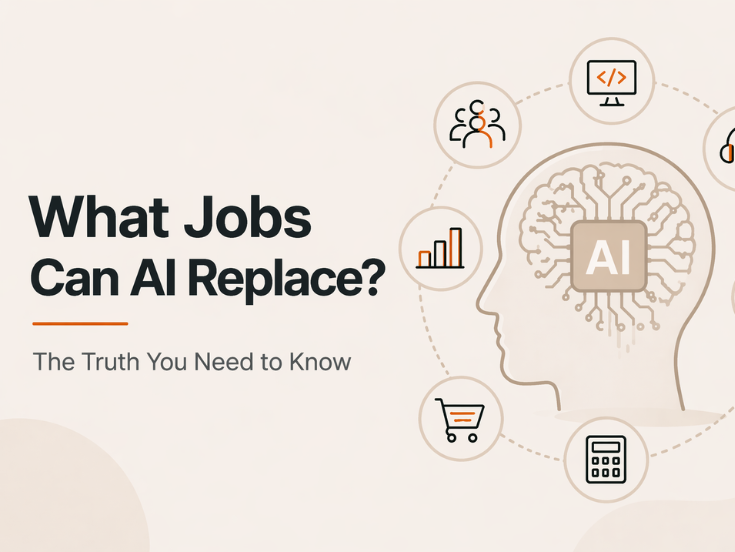
What Jobs Can AI Replace? The 2026 Data Reveals a Clear Pattern
Wondering what jobs can AI replace? 2026 data reveals a clear pattern from entry-level roles to white-collar work. Find out if your job is at risk.

In this article
- The Scale of What’s Coming and What’s Already Here
- Jobs AI Is Actively Replacing Right Now
- The White-Collar Surprise: Who AI Is Actually Targeting
- Jobs AI Will Replace by Industry — The Risk Breakdown
- What Jobs AI Cannot Replace
- Jobs With Low AI Risk Safe Career Categories
- The 2030 Picture: What the Data Actually Projects
- Frequently Asked Questions
- What Actually Protects Your Job From AI
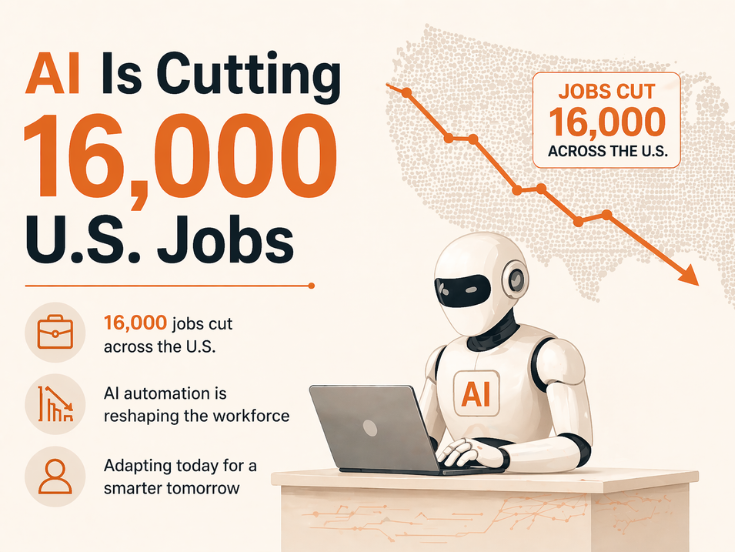
Forty-one percent of companies worldwide say they plan to reduce their headcount because of AI by 2030. That’s not a projection from a think tank — it’s what employers told the World Economic Forum directly. And while that number is alarming on its own, the more unsettling detail is buried underneath it: the cuts are already starting, and they’re hitting workers nobody expected.
The conventional story about AI and jobs has always been about factory workers, truck drivers, and call center agents. The reality emerging from 2025 and 2026 data is messier, more surprising, and in some ways more urgent — because the workers most exposed right now tend to be educated, well-paid, and white-collar. The data on what jobs AI can replace has shifted considerably in the last 18 months. Here’s what it actually shows.
The Scale of What’s Coming and What’s Already Here
Before getting to specific roles, it’s worth grounding the conversation in hard numbers, because the range of estimates is enormous and easy to misread.
The World Economic Forum’s Future of Jobs Report 2025 projects that 92 million jobs will be displaced by 2030, while 170 million new roles will emerge — a net gain of 78 million. That sounds optimistic. And it is, in aggregate. The problem is that job gains and job losses don’t happen to the same people in the same places at the same time.
Goldman Sachs takes a more measured view on the U.S. specifically: their economists estimate generative AI will displace roughly 6–7% of the American workforce over the longer term — approximately 11 million workers. They also note that the transition-period unemployment spike is likely temporary, typically fading within two years as displaced workers find new footing.
What both reports agree on: the wave is not evenly distributed. Some roles face existential risk. Others are barely touched. And the dividing line is not as simple as “manual vs. knowledge work.”
The Capability Gap Nobody Talks About
One of the most important findings to come out of 2026 research isn’t which jobs AI can theoretically replace — it’s the gap between theoretical capability and actual adoption.
Anthropic researchers Maxim Massenkoff and Peter McCrory published internal analysis this year tracking how Claude is actually used in professional contexts. Their finding, detailed in a Fortune report from March 2026: for computer and math workers, large language models can theoretically handle 94% of their tasks. In observed professional use, Claude is covering roughly 33%.
That gap matters. It means AI job displacement is real but still below its technical ceiling. The disruption is not hypothetical — it’s happening now, at partial scale, with more to come.
Jobs AI Is Actively Replacing Right Now
These aren’t predictions. They’re documented, measurable losses already reflected in hiring data, layoff announcements, and industry reports.
Data Entry and Administrative Processing
This was the first category to go, and it’s close to gone. According to 2026 statistics compiled by DemandSage, data entry roles carry a 95% automation risk — and in healthcare specifically, medical transcription is already 99% automated. What used to require a team of people to type, verify, and file is now handled end-to-end by AI systems that do it faster and with fewer errors.
The Bureau of Labor Statistics’ 2025 employment projections officially flag office and administrative support as a category where “automated systems, including AI, are expected to contribute to declining employment.” That’s unusually direct language from a federal agency that prefers hedging.
Customer Service The First Major Casualty
Customer service agents face an 80% projected automation rate. Chatbots and AI voice systems already handle the vast majority of tier-1 support inquiries at major banks, telecom carriers, e-commerce platforms, and airlines without any human in the loop. The remaining human roles are shifting toward handling edge cases and escalations — roles that require judgment, empathy, and situational reading that AI still handles poorly.
The trend is quantifiable: 49% of U.S. companies that have deployed ChatGPT report they have already replaced workers with it, according to survey data cited by DemandSage.
Content Writing and Basic Journalism
Routine content — product descriptions, SEO articles, earnings summaries, sports recaps — is being generated at scale by AI systems at a fraction of human cost. Digital marketing content writer positions are projected to decline by 50% by 2030. Reporter and writer positions overall are expected to shrink by 30%.
This doesn’t mean storytelling, investigative reporting, or original commentary is going away. It means the lower tier of the content market — the commodity writing that funded a lot of entry-level careers — has largely collapsed.
Telemarketers and Outbound Sales
Telemarketers carry the highest documented automation risk of any occupation: 99%. AI voice systems can now make outbound calls, qualify leads, answer objections, and hand off to human closers when necessary — all with zero fatigue and at any hour. This role is effectively automated.
The White-Collar Surprise: Who AI Is Actually Targeting
Here’s the counterintuitive reality that most coverage misses: the workers with the highest theoretical exposure to AI displacement aren’t low-wage service workers. They’re educated professionals with college degrees and mid-to-senior salaries.
The Anthropic research team found that the highest-exposure workers tend to be older, more educated, female, and earning approximately 47% more than their zero-exposure counterparts. This automation wave is targeting white-collar professionals — the people who spent years building credentials for office-based careers.
The paper named a specific scenario: a “Great Recession for white-collar workers.” During 2007–2009, U.S. unemployment doubled from 5% to 10%. The researchers aren’t predicting that outcome as inevitable. They’re identifying it as a plausible trajectory if AI adoption accelerates faster than the labor market can absorb displaced workers.
What’s Happening to Entry-Level Jobs Right Now
The Anthropic data reveals something more immediate than future projections: the damage is showing up in hiring, not layoffs. Entry-level job postings dropped 15% year-over-year as of 2025. In AI-exposed occupations, young workers aged 22–25 have seen a 13–14% decline in employment since late 2022 — not because they were fired, but because the entry-level roles that would have hired them aren’t being created.
This is how labor market disruption often works. It doesn’t begin with mass terminations. It begins with companies quietly not backfilling positions, deciding that a $30/month AI subscription can cover what an entry-level analyst used to do.
Jobs AI Will Replace by Industry — The Risk Breakdown
| Industry | Automation Risk | Key Roles at Risk | Timeline |
|---|---|---|---|
| Administrative / Office Support | 46% of tasks automatable | Data entry, scheduling, basic accounting | Already underway |
| Customer Service | 80% projected | Call center agents, chat support, tier-1 helpdesk | Already underway |
| Financial Services (basic) | 54–70% of basic operations | Loan processors, basic analysts, bookkeepers | 2025–2028 |
| Manufacturing | 45%+ | Assembly line, quality control, logistics coordination | 2025–2030 |
| Transportation | 50% | Long-haul truckers, delivery routing | 2027–2032 |
| Legal (junior) | 65–80% for research tasks | Paralegals, legal researchers, document review | 2025–2028 |
| Healthcare (administrative) | Very High | Medical transcription (99% done), medical coding | Already underway |
| Software Engineering (junior) | Moderate–High | Code completion, testing, basic feature builds | Active — ongoing |
| Retail | 65% | Cashiers, stock management, inventory | Ongoing |
| Content / Marketing | 50% by 2030 | Content writers, basic copywriters, social schedulers | Active — ongoing |
Sources: Goldman Sachs, DemandSage, BLS 2025 Projections, Anthropic 2026 Research
What Jobs AI Cannot Replace
The jobs with the lowest automation risk share a specific set of qualities: they require real-time physical judgment in unpredictable environments, emotional attunement that AI cannot replicate, or the kind of contextual moral reasoning that no model is equipped to perform.
Healthcare (Clinical)
Nurses are among the most AI-resistant workers. Their work demands emotional awareness, physical presence, rapid judgment in shifting conditions, and the ability to read a patient in ways that go well beyond vitals data. AI can surface information and flag anomalies. It cannot hold someone’s hand, adjust tone based on a patient’s fear, or make the call a nurse makes at 2am when something feels off but no monitor confirms it.
Surgeons and physicians in complex care are similar. AI assists — it doesn’t operate.
Mental Health and Therapy
Therapy hinges on trust, timing, and the quality of human presence. The therapeutic relationship itself is the mechanism of change. No AI model can replicate what happens in a room where two people have built years of context, where silence means something, where the therapist’s response is shaped by knowing who you were six months ago.
Skilled Trades
Electricians, plumbers, HVAC technicians, and construction workers operate in environments that change with every job site. No two situations are identical, and the physical dexterity required to work in confined, irregular spaces is something robotic systems are still decades from handling reliably at scale. These roles are undervalued by culture — they’re among the most AI-resistant on the market.
Creative Direction and Original Storytelling
AI can generate content. It cannot decide what deserves to exist. The judgment about what story to tell, what angle serves the audience, what framing shifts a conversation — that remains human. AI is a production tool. The creative vision behind it still belongs to people.
Senior Leadership and Organizational Decision-Making
Leadership involves values, politics, conflicting stakeholder interests, and ethical accountability. A CEO making a call about a layoff, a regulatory strategy, or a public crisis response is navigating terrain where the data is incomplete and the consequences are social. That’s not automatable.
Jobs With Low AI Risk Safe Career Categories
| Job Category | Why AI Can’t Replace It | Automation Risk |
|---|---|---|
| Registered Nurses | Physical care, emotional intelligence, real-time judgment | Very Low |
| Mental Health Counselors | Relationship-based, deeply contextual | Very Low |
| Electricians / Plumbers / HVAC | Physical dexterity, unpredictable environments | Very Low |
| Surgeons | Physical skill, real-time judgment, accountability | Low |
| K-12 Teachers (especially early childhood) | Relationship, behavior management, developmental attunement | Low |
| Social Workers | Emotional judgment, advocacy, case complexity | Low |
| Senior Executives / Strategic Leaders | Values-based decision-making, political navigation | Low |
| UX Researchers | Human insight-gathering, nuanced qualitative judgment | Low–Moderate |
| Criminal Defense Attorneys | Courtroom advocacy, client relationship, moral judgment | Moderate |
| Architects (design) | Creative vision, client relationship, site specificity | Moderate |
Note: “Moderate” indicates partial automation of tasks, not full role replacement.
The 2030 Picture: What the Data Actually Projects
By 2030, the WEF estimates 22% of all jobs will be disrupted — combining both displacement and transformation. McKinsey’s range is wider: between 75 million and 375 million workers globally may need to switch occupational categories by 2030. That range reflects genuine uncertainty about how fast AI adoption moves and how quickly training programs can respond.
The harder demographic reality: women face nearly three times the automation risk of men. DemandSage’s analysis found that 79% of employed women in the U.S. work in high-risk automation categories, compared to 58% of men. The WEF data backs this: jobs most vulnerable to AI task automation make up 9.6% of female employment, roughly three times the proportion for male jobs at 3.2%. That’s not a footnote. It’s a structural inequity being baked into the next decade of labor market disruption.
The International Labour Organization’s own research, published in March 2026, points to the actual mechanism behind that gap: occupational segregation, not any difference in skill or ability.
- Women are concentrated in clerical, administrative, and business support roles, such as secretaries, receptionists, payroll clerks, and accounting assistants, where tasks are routine and easily codified into an AI system
- Men are more concentrated in construction and manufacturing, where physical, situational work is harder to automate
- This same pattern holds in 88% of the countries the ILO analyzed, so it isn’t a US quirk
There’s a second, compounding problem the automation-risk numbers don’t capture on their own: women make up only 30% of the AI workforce itself. That means the group facing the highest displacement risk also has the least representation in the jobs being created to replace what’s automated away, and the least influence over how these systems get designed and deployed in the first place.
Where the New Jobs Are Coming From
The jobs being created aren’t replacements in any direct sense. AI engineers, machine learning specialists, data scientists, and AI ethics researchers are growing fast — AI Engineer roles are expanding at 143.2% annually. But these roles require years of reskilling, not a two-week bootcamp. Workers whose customer service or data entry role automated away cannot simply pivot to AI engineering.
The realistic job creation story for displaced workers is in adjacent roles: AI prompt specialists, AI output reviewers, human-in-the-loop oversight positions, and hybrid roles that pair human judgment with AI output. These exist. They’re growing. But they don’t scale at the volume needed to absorb millions of displaced workers on any near-term timeline.
Frequently Asked Questions
What jobs will AI replace first?
Data entry clerks, telemarketers, and customer service agents are already being replaced at scale. These roles involve structured, repetitive tasks — exactly what current AI handles well. Medical transcriptionists are 99% automated. Telemarketing automation risk sits at 99%. These categories are effectively in the final stages of AI displacement already.
Will AI replace software engineers?
Not entirely, and not soon — but junior software engineers face real pressure. AI tools like GitHub Copilot and Claude handle code completion, basic debugging, and feature scaffolding at a level that compresses how many junior developers companies need to hire. Senior engineers who understand architecture, trade-offs, and business context remain in strong demand. Entry-level coding roles are the ones shrinking.
What jobs are safe from AI automation?
Jobs that require physical dexterity in unpredictable environments (electricians, plumbers, surgeons), emotional attunement over time (therapists, social workers, nurses), and values-based judgment under incomplete information (executives, senior attorneys, crisis managers) remain highly resistant to AI replacement. These roles depend on qualities AI cannot simulate at production quality.
How many jobs will AI replace by 2030?
The WEF Future of Jobs Report 2025 projects 92 million jobs will be displaced by 2030, while 170 million new roles will emerge — a net gain of 78 million. Goldman Sachs estimates the U.S. specifically will see roughly 11 million workers displaced. These figures reflect projections, not guarantees, and depend heavily on how quickly companies adopt AI tools at scale.
Will AI replace doctors?
Not clinical doctors in complex care. AI is already transforming radiology, pathology analysis, and diagnostic support — but as an assistant, not a replacement. The physical examination, patient relationship, and ethical accountability of clinical medicine remain human responsibilities. Administrative and documentation tasks in healthcare are far more vulnerable.
Is AI replacing jobs faster for younger workers?
Yes. Anthropic’s 2026 labor market research found a 14% drop in job-finding rate among workers in AI-exposed occupations since 2022 — and the impact falls hardest on workers aged 22–25. Entry-level job postings dropped 15% year-over-year. The problem isn’t mass layoffs of experienced workers — it’s that the entry-level rungs of many careers are being automated before young workers can get their footing.
What Actually Protects Your Job From AI
The honest answer is not “be more creative” or “develop soft skills” — those are real factors, but they’re too vague to act on.
The more useful framing: the roles that survive AI disruption are those where the cost of an AI error is high, where the judgment required is contextual and cannot be codified, and where human presence is part of the service itself.
A nurse whose error causes patient harm bears legal and professional accountability. That accountability structure keeps humans essential in ways that no cost-efficiency calculation can override. A therapist whose presence and history with a patient is the mechanism of treatment cannot be swapped out for a chatbot without destroying the therapy itself.
The safest careers in the AI era share one quality: they require something a model cannot simulate at the quality the job demands. Everything else is on a timeline. The question isn’t whether AI will automate parts of your role — it will. The question is whether the parts it automates leave the meaningful core of your work intact, or hollow it out entirely.
The workers who navigate this best will be the ones who stop asking ‘Will AI replace my job?’ and start asking something sharper: ‘What does my role require that AI demonstrably cannot do yet — and how do I make that the center of what I do?’
Every number, date and quote in this article links to its source. Spotted a mistake? Tell us and we will correct it with a dated note. Read our editorial policy.