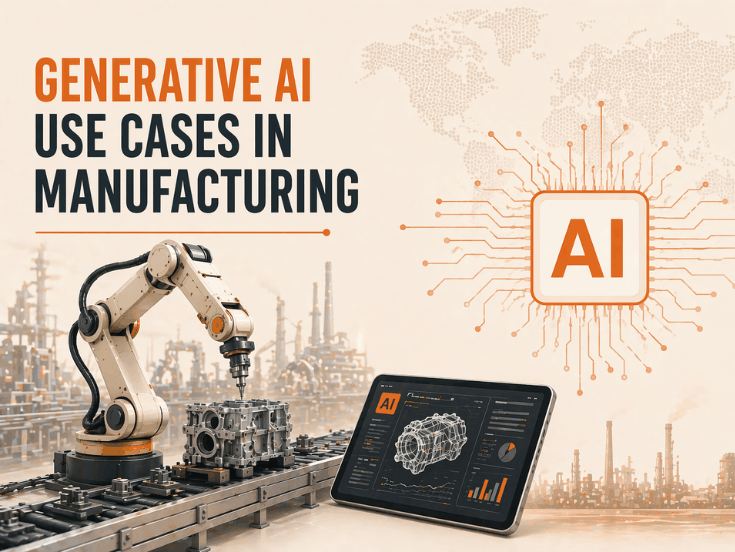
Generative AI Use Cases in Manufacturing
Walk the floor of a modern BMW plant in Regensburg and you’ll see something the brochures don’t quite capture: the quality inspectors aren’t the only ones watching. Twenty-six cameras track every vehicle moving down the line, and an AI model trained on years of defect data flags problems before a human eye could catch them. The stud-correction laser alone saves the company more than $1 million a year.
That is what the generative AI use cases in manufacturing actually look like in 2026 not a sci-fi takeover, but targeted, measurable wins inside very specific workflows. The hype cycle has cooled, the pilots have produced receipts, and a clear set of applications now separate the manufacturers getting real returns from the ones still running slideshows. This piece walks through the use cases that are paying off, the companies proving it, and the numbers that matter.
What actually counts as generative AI in manufacturing
Traditional AI in factories computer vision for defect detection, regression models for forecasting has been around for years. Generative AI is different. It creates new outputs: designs, text, code, synthetic training data, work orders, simulations.
In manufacturing, that usually means one of two things. Either a large language model is reading and writing text at scale work instructions, maintenance logs, supplier emails, compliance documents or a generative design model is producing thousands of candidate part geometries a human engineer would never think to try. The most valuable deployments bolt these generative layers on top of the traditional AI stack the plant already runs, not in place of it.
That distinction matters, because the McKinsey Global Institute estimates generative AI could add $2.6 trillion to $4.4 trillion in annual value across industries, with manufacturing and supply-chain applications alone capable of cutting expenses by roughly half a trillion dollars (McKinsey, 2023). But only a slice of that value shows up in the use cases below.
1. Generative product design
This is the use case with the longest track record and the easiest math. An engineer sets the constraints load, material, mounting points, manufacturing method and a generative model produces hundreds or thousands of candidate geometries, usually surfacing options that are lighter, stronger, or cheaper than what a human would draw.
General Motors worked with Autodesk’s generative design software and redesigned a seat-bracket component that came out 40% lighter and 20% stronger than the original; across 14 models, the weight savings added up to more than 350 pounds per vehicle. Airbus used the same approach on an A320 cabin partition and cut its weight by 45% while keeping structural integrity intact. Eaton, the power-management firm, has reported an 87% reduction in design time on certain components after bringing generative AI into its engineering workflow.
The business case is usually straightforward: lighter parts mean less material cost, better fuel efficiency in automotive and aerospace, and shorter engineering cycles. This is one of the few generative AI applications where the ROI math has held up since 2019.
2. Predictive maintenance that writes its own work order
Traditional predictive maintenance sensor data in, failure probability out is not new. What generative AI adds is the last mile. When a pump starts drifting, the model doesn’t just raise an alert. It writes the work order, pulls the relevant section of the service manual, lists the parts needed, and drafts the technician’s instructions.
Siemens has reported a 20% reduction in machine downtime from generative-AI-assisted predictive maintenance across its production footprint. At BMW’s Regensburg plant, an AI-supported maintenance system that monitors conveyor technology during assembly prevents over 500 minutes of downtime each year on that line alone.
The broader pattern is consistent. Well-instrumented predictive maintenance programs can cut unplanned downtime by up to 50%, extend machine life by up to 40%, and lower maintenance costs by roughly 25% (IBM, 2025). The reason documentation-heavy applications tend to deliver the fastest ROI — typically within 6 to 12 months — is that the generative layer sits on top of data the plant was already collecting.
3. AI-driven quality control and defect detection
Computer vision for defect detection has been a manufacturing staple for a decade. What changed is that generative models can now explain their own decisions and create synthetic defect images to train inspection systems where real defects are rare.
BMW’s AIQX (Artificial Intelligence Quality Next) platform runs at its Regensburg plant, using 26 cameras across the line and AI models that analyze images in real time. A related pilot called GenAI4Q produces tailored inspection recommendations for each of the roughly 1,400 vehicles the plant builds per day. HCLTech’s manufacturing quality agent, built on Google Cloud’s Vertex AI and Cortex framework, predicts and helps eliminate defects on specific production lines and is now in use at several Google Cloud manufacturing customers.
The results show up where they should. One automotive supplier deployed an AI-powered “scrap adviser” and cut scrap rates by 25%, while an AI-driven visual inspection system reduced the number of required quality-control staff by 65% and improved inspection accuracy at the same time (Glean, 2025). For manufacturers with tight margins, the scrap number alone justifies the investment.
4. Supply chain planning and demand forecasting
Manufacturing’s post-2020 supply-chain lessons are baked in now. Most large manufacturers maintain a forecasting stack, and generative AI is being grafted onto it in three ways: reading qualitative inputs (supplier emails, news, sensor alerts) and turning them into planning signals; summarizing cross-functional data into a single narrative planners can act on; and drafting replenishment scenarios for review.
Siemens built machine-learning models that forecast demand using signals from its ERP, sales, and supplier networks, with generative models proposing optimized inventory levels and replenishment schedules across regions. Moglix, an Indian digital supply-chain platform serving more than 1,000 manufacturing businesses, deployed Vertex AI to power vendor discovery and MRO (maintenance, repair, operations) supplier matching (Google Cloud, 2024).
This is an area where generative AI is rarely the sole decision-maker. It’s a copilot for planners — surfacing options, writing up recommendations, flagging anomalies. The productivity gains are real but less headline-grabbing than the design and quality numbers.
5. Digital twins and factory simulation
A digital twin is a live, data-linked virtual replica of a physical asset. Generative AI makes twins useful in two ways: it creates the twin faster (generating 3D assets, synthetic sensor data, and scenarios) and it runs “what if” simulations without a human having to code each one.
BMW’s Virtual Factory, built on NVIDIA Omniverse, integrates data from buildings, equipment, logistics, and vehicles into real-time 3D simulations. BMW reports 5x productivity gains and 30x faster simulation speeds compared with the previous approach, and projects planning-cost reductions of up to 30%. Manufacturers running generative-AI-assisted simulations on production-line configurations before physical changes have reported up to 70% reductions in assembly-process failure rates on complex builds (Latent View, 2026).
The caveat: digital twins pay off when the underlying data is clean and live. Plants that still run on paper checklists and weekly reports will struggle to justify the investment without fixing the data plumbing first.
6. Shop-floor copilots and work instructions
This is the use case that didn’t exist three years ago and is quietly becoming the largest in headcount terms. A shop-floor copilot is a chat-style interface — often on a tablet or AR headset — that technicians can query in plain language: “What’s the torque spec for bolt 4 on this assembly?” “How do I reset the calibration on this machine?” The model pulls from service manuals, engineering drawings, maintenance history, and tribal knowledge captured in past tickets.
Generative AI generates dynamic work instructions that adapt to the specific unit in front of the worker, drafts standard operating procedures from raw engineering documents, and summarizes long shift handoff notes into quick briefings. US Steel is building applications on Google Cloud’s generative AI stack to speed up repairs and reduce downtime in its iron-ore mining operations — with the stated goal of making technician work more satisfying, not just faster.
The payoff is less dramatic per seat than generative design, but it scales. A 5–10% improvement in task-completion time across 5,000 technicians is the kind of number finance teams actually care about.
Where generative AI adoption in manufacturing actually stands in 2026
The hype has outrun the deployment data for most of the last three years. That gap is finally narrowing. Deloitte’s 2025 Smart Manufacturing and Operations Survey puts hard numbers on it:
| Stage of Generative AI Adoption | % of Manufacturers |
| Deployed GenAI at facility or network level | 24% |
| Piloting GenAI use cases | 38% |
| Using traditional AI/ML at facility or network level | 29% |
| Concerned about workforce upskilling | 35% |
Source: Deloitte, 2025 Smart Manufacturing and Operations Survey deloitte.com
The read here is that roughly six out of ten manufacturers are either live or piloting — a meaningful jump from early 2024 — but deployment at scale is still the minority position. The bottleneck is rarely the model. It’s data quality, change management, and a workforce skills gap that a third of executives flag as a top concern.
The market context reinforces the trajectory. The broader AI-in-manufacturing market is forecast to grow from roughly $7.6 billion in 2025 to $62.3 billion by 2032, a 35% compound annual growth rate (Fortune Business Insights, 2025). Spending is real. Value capture is uneven.
The ROI conversation nobody wants to have
Most generative AI manufacturing pilots do not return measurable value in their first six months. That is not a failure of the technology — it’s a failure of scoping. The deployments that pay off early share a few characteristics.
They target a well-defined workflow with existing digital data. Predictive maintenance on sensor-instrumented equipment pays back faster than generative design on a product line whose drawings live in PDFs on a shared drive. They produce outputs a human actually uses. A work-instruction copilot that technicians ignore delivers zero value, regardless of its benchmark score. And they have a clear metric tied to plant P&L — scrap rate, unplanned downtime, first-pass yield, engineering hours per part.
Against that standard, the numbers are encouraging. Seventy-eight percent of executives with live generative AI deployments report measurable returns, and manufacturers with multiple applications in production report aggregate ROIs of 200–400%, usually over a one-to-three-year horizon (AppInventiv, 2025). The laggards are rarely laggards because the models don’t work. They’re laggards because they picked use cases that didn’t fit their data, their people, or their production reality.
The practical playbook looks like this: start with two or three high-value, clearly scoped use cases; prove the value in a single plant; then scale. Manufacturers trying to generative-AI everything at once mostly end up generative-AI-ing nothing.
Frequently Asked Questions
What is generative AI in manufacturing?
Generative AI in manufacturing refers to AI models — most often large language models or generative design models — that create new outputs such as designs, work instructions, maintenance orders, code, or synthetic data. It sits on top of existing manufacturing software and plant data, complementing traditional AI used for forecasting and defect detection rather than replacing it.
What are the main use cases of generative AI in manufacturing?
The most deployed use cases in 2026 are generative product design, predictive maintenance with auto-generated work orders, AI-driven quality control, supply-chain and demand forecasting, digital twins and factory simulation, and shop-floor copilots that answer technician questions in plain language and generate dynamic work instructions.
How is generative AI used in product design?
Engineers specify constraints — load requirements, material, manufacturing method, mounting points — and generative design software produces hundreds of candidate geometries. Teams at General Motors, Airbus, and Eaton have used this approach to cut part weight by 30–45% and reduce design cycle time by as much as 87%, freeing engineers to focus on integration rather than first-draft geometry.
Which companies are using generative AI in manufacturing?
Named deployments include BMW (AIQX quality system and GenAI4Q pilot at Regensburg, plus the NVIDIA-powered Virtual Factory), Siemens (predictive maintenance and supply-chain forecasting), General Motors (generative design with Autodesk), Airbus (lightweight cabin components), Eaton (design-cycle acceleration), US Steel (Google Cloud generative AI for mining operations), and HCLTech’s manufacturing quality agent used across multiple Google Cloud customers.
What are the benefits of generative AI in manufacturing?
The measured benefits include lower scrap rates, reduced unplanned downtime, faster engineering cycles, lighter and cheaper parts, better demand forecasts, and more productive technicians. Across deployments, manufacturers report ROIs of 200–400%, typically over a one-to-three-year window, with documentation and maintenance use cases paying back fastest.
Is generative AI worth the investment for small and mid-size manufacturers?
It can be, but scope matters. Smaller manufacturers rarely get a return from trying to replicate BMW-scale deployments. The more reliable path is picking one workflow with clean digital data — usually documentation automation, a shop-floor copilot, or targeted predictive maintenance — and proving value on a single line before scaling. Cloud-based tools have made the entry cost substantially lower than it was even in 2023.
Where this goes next
The interesting question for 2026 and 2027 isn’t whether generative AI will be used in manufacturing — that debate is over. It’s which applications survive the pilot-to-production cliff, and which become permanent fixtures on the plant floor.
The early signals point the same direction the data has for two years: quality control, predictive maintenance, and shop-floor copilots are the workhorses. Generative design keeps producing the headline numbers. Digital twins are the bet with the longest payback but the highest ceiling. What separates the manufacturers capturing value from the ones still running pilots isn’t model choice. It’s whether they treat generative AI as a tool for specific workflows or as a platform play. The workflow-first ones are the ones putting money in the bank.