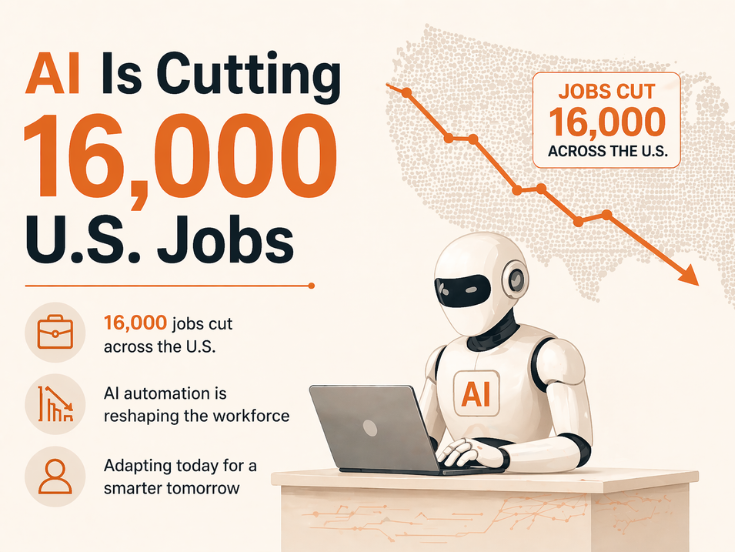
16,000 jobs. Every month. That’s not a projection it’s Goldman Sachs’ current measurement of what AI is already doing to U.S. employment.
When economists broke the number apart, it looked like this: AI is substituting roughly 25,000 jobs per month, while creating back about 9,000 through augmentation. Net result 16,000 Americans per month losing work to a technology most of their employers adopted within the past three years.
The workers absorbing most of that impact are the ones who can least afford it. Gen Z is entering a labor market that is structurally different from the one any previous generation faced, and the data from multiple independent institutions is now consistent enough that dismissing it as overblown doesn’t hold up.
What the Goldman Sachs Numbers Actually Show
The Goldman Sachs analysis, published in early April 2026 and authored by economist Elsie Peng, is one of the most rigorous attempts to separate AI’s two competing effects on employment not just report a headline number.
Substitution vs. Augmentation The Key Distinction
AI interacts with the job market in two distinct ways, and the difference matters enormously:
Substitution: AI replaces a human doing a task outright. The role doesn’t get filled. Headcount drops.
Augmentation: AI makes an existing worker more productive. Fewer people are needed for the same output, but the workers who remain often earn more and do higher-level work.
Right now, substitution is winning nearly 3-to-1 in net job impact. The 25,000 jobs destroyed versus 9,000 created tells you which force is currently dominant. What’s less obvious from the headline is where each force concentrates — and that’s where the Gen Z problem becomes clear.
Why Gen Z Is Taking the Hardest Hit
The displacement isn’t showing up as mass layoffs of experienced workers. It’s showing up as a quiet collapse in entry-level hiring.
Companies that used to bring in two or three junior analysts, coordinators, or developers are now managing the same workload with one experienced hire and a stack of AI tools. The entry-level jobs never get posted. The interviews never happen.
The Entry-Level Hiring Collapse
| Job Category | Entry-Level Decline | Primary AI Substitution |
|---|---|---|
| Software Development (Junior) | 67% drop in postings since 2022 | AI code generation tools |
| Customer Service | ~80% automation potential | LLM-based support agents |
| Data Entry & Processing | ~65% automation potential | Automated data pipelines |
| Legal Support (Paralegal/Clerk) | ~44% task automation | Document analysis AI |
| Administrative Roles | ~46% task automation | Scheduling & workflow AI |
| Medical Records Specialist | ~60% automation potential | AI coding & transcription |
Sources: Dallas Federal Reserve, Jan 2026; Anthropic Labor Market Report, Mar 2026
Workers aged 22–25 in the most AI-exposed occupations have seen a 6–16% employment drop since late 2022 — not from firings, but from a hiring slowdown. Separately, 58% of 2024 and 2025 Gen Z graduates are still searching for their first job, compared to just 25% of millennial and Gen X graduates at the same career stage. The ServiceNow CEO warned in March that new graduate unemployment could reach 30% within a few years if the trajectory continues.
Three Major Institutions Saying the Same Thing
This isn’t one firm’s number. Three independent research bodies reached the same basic conclusion through different methods.
Anthropic’s Own Labor Market Research
In March 2026, Anthropic published “Labor market impacts of AI: A new measure and early evidence”, using real Claude usage data to measure job exposure. The research found direct evidence that hiring of workers aged 22–25 has slowed in AI-exposed occupations. CEO Dario Amodei has separately warned that AI could eliminate 50% of all entry-level white-collar roles and push unemployment to 10–20% in a severe scenario. The most exposed occupations: computer programmers (75% task coverage), customer service reps, and data entry specialists.
Dallas Fed: Experience Has Become a Shield
The Federal Reserve Bank of Dallas has been tracking the experience divide in real time. Their January 2026 analysis found that AI automates codifiable, textbook knowledge precisely what entry-level workers primarily bring — while augmenting the tacit, experiential knowledge of senior workers. The result: wages in the top decile of AI-exposed industries grew 8.5%, while entry-level positions in those same industries declined 16%. In computer systems design specifically, senior wages rose 16.7% more than double the national average. The gap is widening fast.
Gallup: 50% of American Workers Now Use AI on the Job
Gallup’s Q1 2026 workplace survey crossed a meaningful threshold: for the first time, 50% of employed American adults use AI at work up from just 21% in mid-2023. Among them, 65% say it’s boosting productivity. But 1 in 5 workers say AI has already replaced tasks that were previously part of their job description. Task replacement precedes role replacement and it’s happening at scale right now.
Which Jobs Face the Highest AI Exposure Right Now
| Occupation | AI Task Coverage | Current Trend |
|---|---|---|
| Computer Programmer | ~75% | Sharp hiring decline |
| Customer Service Rep | ~70% | Automated support agents replacing entry tiers |
| Data Entry Specialist | ~65% | Largely automated in major enterprises |
| Paralegal / Legal Clerk | ~44% | Document review increasingly AI-driven |
| Medical Records Specialist | ~60% | AI coding tools widely adopted |
| Copywriter / Content Writer | ~55% | AI-assisted or replaced in volume content |
| Junior Financial Analyst | ~50% | Data analysis and reporting heavily automated |
| Administrative Assistant | ~46% | Scheduling, email, and workflow AI |
Source: Anthropic Labor Market Report, March 2026; Washington Post AI Job Vulnerability Tracker, 2026
The Other Side of the Data
It would be inaccurate to present this as a story of uniform collapse. The World Economic Forum projects AI will displace 92 million jobs globally by 2030 — but also create 170 million new roles, for a net gain of roughly 78 million. BCG’s 2026 research argues AI will reshape more jobs than it eliminates over the next five years.
In February, IBM announced it’s tripling Gen Z entry-level hiring after discovering the hard limits of pure AI adoption. Some work still requires humans who can adapt, make judgment calls, and interface with real-world complexity.
The split is sharp: AI handles structured, repetitive, and codifiable work well. It handles judgment, physical presence, and interpersonal complexity poorly. The problem for Gen Z is that most entry-level jobs currently fall into the first category.
What Gen Z Can Actually Do Right Now
Build AI fluency before the job market asks for it: Workers who enter with hands-on knowledge of AI tools — knowing how to prompt, evaluate output, and fit AI into real workflows — are already differentiated. 37% of employers say they’d rather use AI than hire a recent graduate for certain roles. The response isn’t to avoid AI — it’s to become the person who deploys it better than anyone else.
Move toward roles built on tacit knowledge: The Dallas Fed research is explicit: codifiable knowledge is what AI replaces; tacit knowledge built through experience and judgment is what AI augments. Healthcare, skilled trades, strategic advisory roles, and work requiring physical presence carry real protective value right now.
Do an honest audit of your current role: If most of your tasks are structured, repetitive, and rule-based, the timeline to automation is shorter than it was two years ago. Repositioning toward decision-making, quality control, or client-facing complexity isn’t just good career advice — it’s what the data recommends.
Frequently Asked Questions
How many U.S. jobs is AI cutting per month in 2026?
According to Goldman Sachs’ April 2026 analysis, AI is cutting approximately 16,000 net U.S. jobs per month. That figure reflects roughly 25,000 jobs displaced through substitution, partially offset by about 9,000 new positions created through AI-driven augmentation.
Why is Gen Z getting hit harder by AI job losses than older workers?
Gen Z workers are disproportionately concentrated in entry-level, routine, white-collar roles — data entry, customer service, legal support, junior software development — precisely the tasks AI automates most effectively. Experienced workers hold tacit knowledge that AI augments rather than replaces, and they’re seeing wage gains as a result.
Which jobs are most at risk from AI in 2026?
Computer programmers (75% task coverage), customer service reps, data entry specialists, paralegals, medical records clerks, junior financial analysts, and administrative assistants rank among the highest exposure occupations, based on Anthropic’s March 2026 labor market research.
Is AI creating any new jobs while it eliminates others?
Yes, but at a slower rate than displacement right now. The World Economic Forum projects AI will create 170 million new roles globally by 2030 while displacing 92 million — a net gain of roughly 78 million. The challenge is that the new roles require meaningfully different skills, and the transition gap is what’s creating current pain for entry-level workers.
What can Gen Z workers do to protect their careers from AI?
Build genuine AI fluency, move toward roles involving tacit knowledge and human judgment, and honestly assess which parts of your current job AI already handles better. The Dallas Fed research is clear that workers who pair experience with AI skills are pulling ahead — the goal is to be on the right side of the augmentation effect, not the substitution effect.
The Transition Is Already Underway
The debate about whether AI will affect jobs is over. It’s affecting jobs right now — 16,000 per month by the most credible current measurement, concentrated at the bottom of the experience ladder where Gen Z is just beginning to climb.
The real question is how fast the new roles AI creates will arrive and whether displaced workers will have the runway to reach them. If past technological transitions are any guide, the gap between destruction and creation is where the actual damage happens. Right now, that gap is open and widening. Watching it closely isn’t optional anymore.