By 2025, 80% of Google’s advertising customers were already using at least one AI-powered ad product — not as an experiment, but as the backbone of their campaign strategy. That number didn’t happen by accident. It happened because Google AI started delivering results that manual targeting simply couldn’t match.
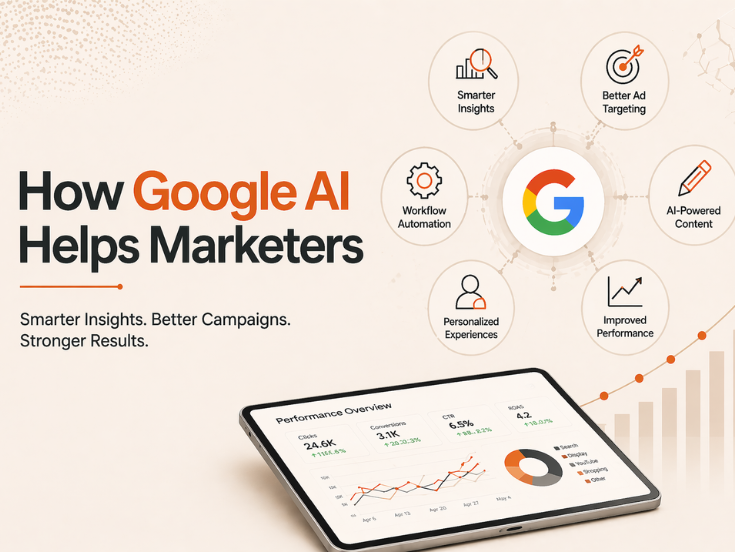
For marketers trying to figure out how Google AI can help reach potential customers, the short answer is this: it does it by reading intent signals, predicting purchase behavior, and automatically placing ads in front of people who are most likely to act. The longer answer involves six distinct tools, each solving a different part of the targeting problem — and each backed by performance data that’s hard to argue with.
The Core Mechanism How Google AI Reads What Customers Actually Want
Signals Beyond Keywords
Google processes more than 8.5 billion searches per day. Inside each one, the AI isn’t just reading words — it’s reading context. Device type, time of day, location, search history, past purchase behavior, browsing patterns across the web, YouTube watch history: all of these feed into a real-time picture of where a user is in their decision process.
Someone searching for “running shoes” could be casually curious or three days from buying. Google AI reads the surrounding signals to tell the difference. That distinction matters enormously to an advertiser deciding whether to bid $0.50 or $4.00 on that click.
Why Intent Matters More Than Demographics
Traditional advertising targeted people based on who they are — age, gender, income bracket. Google AI targets based on what they’re about to do. A 55-year-old grandfather and a 22-year-old college student can have identical purchase intent for the same product in the same moment. Demographic targeting would treat them differently. Intent-based AI targeting sees them as equally valuable.
This is the foundational shift. And every Google AI advertising tool builds on it.
Smart Bidding Winning the Auction Before It Starts
How Smart Bidding Works
Every Google ad runs through an auction. Before Google AI, marketers set manual bids — fixed amounts they were willing to pay per click, regardless of context. Smart Bidding replaced that with real-time, auction-by-auction optimization. For each individual search, Google’s machine learning calculates the probability of a conversion happening and sets the bid accordingly.
Advertisers choose their goal — Target CPA (cost per acquisition), Target ROAS (return on ad spend), Maximize Conversions, or Maximize Conversion Value. Smart Bidding then works backward from that goal, adjusting bids thousands of times per day based on incoming signals. No human can do this at that speed or scale.
What the Numbers Show
Google’s own data shows that Smart Bidding reduces cost per acquisition by up to 37% while improving return on ad spend by up to 30% compared to manual bidding. Marketers who adopt the strategy also report saving five-plus hours per week on bid management — time that gets redirected to strategy and creative work. Google Ads Help — Smart Bidding
These aren’t marginal improvements. A 37% CPA reduction means an advertiser spending $10,000 a month to acquire customers can cut that to roughly $6,300 without changing a single ad.
Performance Max One Campaign Across Every Google Surface
How Performance Max Works
Before Performance Max, running ads across Google Search, YouTube, Display, Gmail, Discover, and Maps required separate campaigns for each channel. Performance Max collapsed all of that into a single campaign. The advertiser supplies the conversion goals, budget, and creative assets — images, videos, headlines, descriptions. Google AI then automatically allocates spend across channels, tests creative combinations, and shifts budget toward whichever placements are converting best.
The system connects signals across all of Google’s inventory simultaneously, finding customers at the moment they’re most likely to convert, regardless of which Google surface they happen to be using.
Performance Max Results
Advertisers who add Performance Max to their existing Search campaigns see an average 18% increase in total conversions at a similar cost per action, according to Google’s data. Google — Performance Max Over 1 million advertisers globally now run Performance Max campaigns. The system made 90-plus quality improvements in 2024 alone, automatically lifting conversion rates by more than 10% across those campaigns without requiring any advertiser action.
| Google AI Advertising Tool | What It Does | Best For | Key Stat |
|---|---|---|---|
| Smart Bidding | Optimizes bids in real-time per auction | Any advertiser with conversion tracking | 37% lower CPA, 30% higher ROAS |
| Performance Max | Runs AI-optimized ads across all Google surfaces | Broad reach with clear conversion goals | 18% more conversions at similar CPA |
| Responsive Search Ads | AI tests and assembles best-performing ad copy | Search advertisers optimizing click-through | Up to 15% more clicks vs. standard ads |
| Demand Gen | Finds new customers on YouTube, Discover, Gmail | Brand awareness + new audience acquisition | 26% more conversions per dollar |
| AI Max for Search | Expands keyword reach with intent-based targeting | Advertisers on exact/phrase match keywords | 14% more conversions at similar CPA |
| Ads in AI Overviews | Places ads inside AI-generated search answers | High-intent query capture in AI-first search | AI Overviews now trigger on 13%+ of queries |
Sources: Google Ads official pages; Google Marketing Live 2025
Responsive Search Ads AI-Written Copy That Adapts in Real Time
How RSAs Work
Responsive Search Ads give marketers a new role in the creative process: supply the raw material, let the AI assemble and test it. Advertisers write up to 15 headlines and 4 descriptions. Google AI then automatically tests thousands of combinations, learning over time which pairings perform best for different users, different queries, and different contexts.
Someone searching for “cheap flights to Miami” might see a headline emphasizing price. Someone searching for “direct flights to Miami” sees the same advertiser’s ad — but with a headline emphasizing convenience. The underlying ad is the same; the AI personalized the assembly.
Why RSAs Matter for Marketers
The practical implication is significant: instead of running A/B tests that take weeks to produce statistically valid results, RSAs run thousands of creative experiments simultaneously and route impressions to the winning combinations automatically. Google data shows RSAs generate up to 15% more clicks than expanded text ads at a comparable cost. Google Ads Help — AI-Powered Search Ads
For marketers managing large product catalogs or multiple audience segments, this means campaigns that continuously improve without requiring manual creative refreshes every quarter.
Demand Gen Reaching Customers Before They Start Searching
How Demand Gen Finds New Customers
Most advertising tools wait for a customer to express intent — they search, they click, they land somewhere. Demand Gen works earlier in the process. It identifies audiences on YouTube, YouTube Shorts, Gmail, and Google Discover — surfaces where people are consuming content, not actively searching — and targets them based on behavioral signals that suggest they’re likely to become interested in a product category.
The AI builds audiences by finding users who share characteristics with an advertiser’s existing customers. It surfaces ads in their feeds before they’ve typed a single search query. By the time they do search, they’ve already encountered the brand.
Demand Gen Performance Data
In 2025, Google reported that Demand Gen campaigns drove a 26% increase in conversions per dollar, driven by over 60 AI-powered improvements to bidding, ramp time, and audience modeling. Google Marketing Live 2025 Demand Gen has also introduced Promoted Pins on Google Maps, allowing advertisers to reach users actively browsing nearby locations and drive direct foot traffic to physical stores.
For brands trying to grow beyond their existing audience — not just recapture people who already know them — Demand Gen is the tool specifically built for that problem.
AI Max for Search Google’s Newest Targeting Layer
What AI Max Does Differently
AI Max for Search, which entered global beta in late 2025, is Google’s most aggressive step toward fully AI-managed search targeting. The system uses two mechanisms in combination: broad match expansion to surface ads for relevant queries that an advertiser’s keyword list wouldn’t have captured, and keywordless targeting, which allows the AI to serve ads based purely on landing page content and campaign intent — no keyword needed at all.
For marketers who have historically relied on tightly controlled exact-match and phrase-match keyword lists, AI Max represents a meaningful shift in how campaigns are structured. The AI decides what qualifies as a relevant search, not the marketer.
Early Performance Results
Early adopters of AI Max for Search report 14% more conversions at a similar cost per acquisition compared to campaigns running without it. Google Ads Help Campaigns that had been heavily relying on exact and phrase match keywords saw improvements as high as 27% in some cases. Independent analysis from SMEC showed a 13% conversion value lift, though with some variability in ROAS — suggesting AI Max performs best when conversion tracking is robust and historical campaign data is deep. Search Engine Journal
The trade-off: less control over which specific queries trigger ads. For advertisers comfortable with that trade, the conversion lift is real.
Ads in AI Overviews and AI Mode The 2025 Shift Marketers Can’t Ignore
What’s Changing
Google’s AI Overviews the AI-generated summaries that appear at the top of search results — now trigger on more than 13% of all queries, a figure that surged 102% between January and March 2025. Google has since expanded ads directly within those AI Overviews, meaning commercial results can now appear inside the AI-generated answer itself — not just below it.
Google is also rolling out AI Mode, a fully conversational search experience, and has confirmed that ads will be integrated into AI Mode results. Think with Google For high-intent commercial queries, this creates a new placement opportunity at the highest-visibility position in the search results page.
What Marketers Should Do Now
The practical implication: campaigns that are already structured around conversion goals, strong creative assets, and accurate conversion tracking will be first to benefit as these placements scale. Advertisers who are still running manually-managed, keyword-restricted campaigns without Smart Bidding are the least likely to appear in these new surfaces — because Google AI decides ad placement in AI Overviews and AI Mode automatically.
The architecture of the campaign matters as much as the budget. Google Marketing Live 2025
Frequently Asked Questions
How does Google AI help marketers reach potential customers?
Google AI analyzes real-time intent signals — including search history, device type, location, and browsing behavior — to predict which users are most likely to convert on a given query. It then automatically adjusts bids, assembles ad creative, and allocates budget across channels to put ads in front of those users at the right moment. The system operates continuously, improving campaign performance without requiring manual adjustments from the marketer.
What is Smart Bidding in Google Ads?
Smart Bidding is a set of automated bid strategies that use Google’s machine learning to optimize bids in real time at the individual auction level. Advertisers set a performance goal — such as a target cost per acquisition or return on ad spend — and the AI calculates the optimal bid for each auction based on dozens of contextual signals. Google data shows Smart Bidding reduces cost per acquisition by up to 37% compared to manual bidding.
What is Performance Max and how does it work?
Performance Max is a single campaign type that runs AI-optimized ads across all of Google’s advertising inventory — Search, YouTube, Display, Gmail, Discover, and Maps — simultaneously. Advertisers provide their conversion goals, budget, and creative assets. Google AI then automatically tests creative combinations, allocates spend across channels, and shifts budget toward the placements generating the most conversions. On average, Performance Max delivers 18% more conversions at a similar cost per action.
What is Demand Gen in Google Ads?
Demand Gen is a Google Ads campaign type designed to reach customers earlier in the purchase journey — before they start actively searching. It runs ads on YouTube, YouTube Shorts, Gmail, and Discover, targeting users based on behavioral patterns that signal future purchase intent. In 2025, Google reported a 26% increase in conversions per dollar across Demand Gen campaigns, driven by improvements to AI bidding and audience targeting.
Can small businesses benefit from Google AI advertising tools?
Yes — and in some ways, small businesses stand to gain more than large ones, because Google AI removes the need for dedicated bid management expertise. Smart Bidding automates what would otherwise require a specialist. Performance Max handles multi-channel distribution from a single campaign. The barrier is setup quality: campaigns need accurate conversion tracking, clear goals, and strong creative assets to give the AI enough signal to optimize effectively. The tools themselves don’t require a large budget to start.
Where This Is All Heading
The data from 2025 tells a clear story. Marketers who have adopted Google’s AI tools — Smart Bidding, Performance Max, Demand Gen — are outperforming those who haven’t, not by small margins but by double-digit percentages across conversion rates, cost per acquisition, and return on ad spend. That gap is going to widen.
Google has signaled its roadmap through 2026: agentic AI capabilities that let the AI manage campaigns with minimal human input, deeper integration of ads into AI search experiences, and creative tools powered by Veo and Imagen that generate video and image assets automatically. The underlying principle driving all of it is the same one that makes Smart Bidding work — the more context the AI has, the better it performs.
For marketers, the question isn’t whether to use these tools. It’s how quickly they can get their campaigns structured in a way that gives the AI what it needs to work. The ones who figure that out first will have a structural advantage that’s difficult to close.