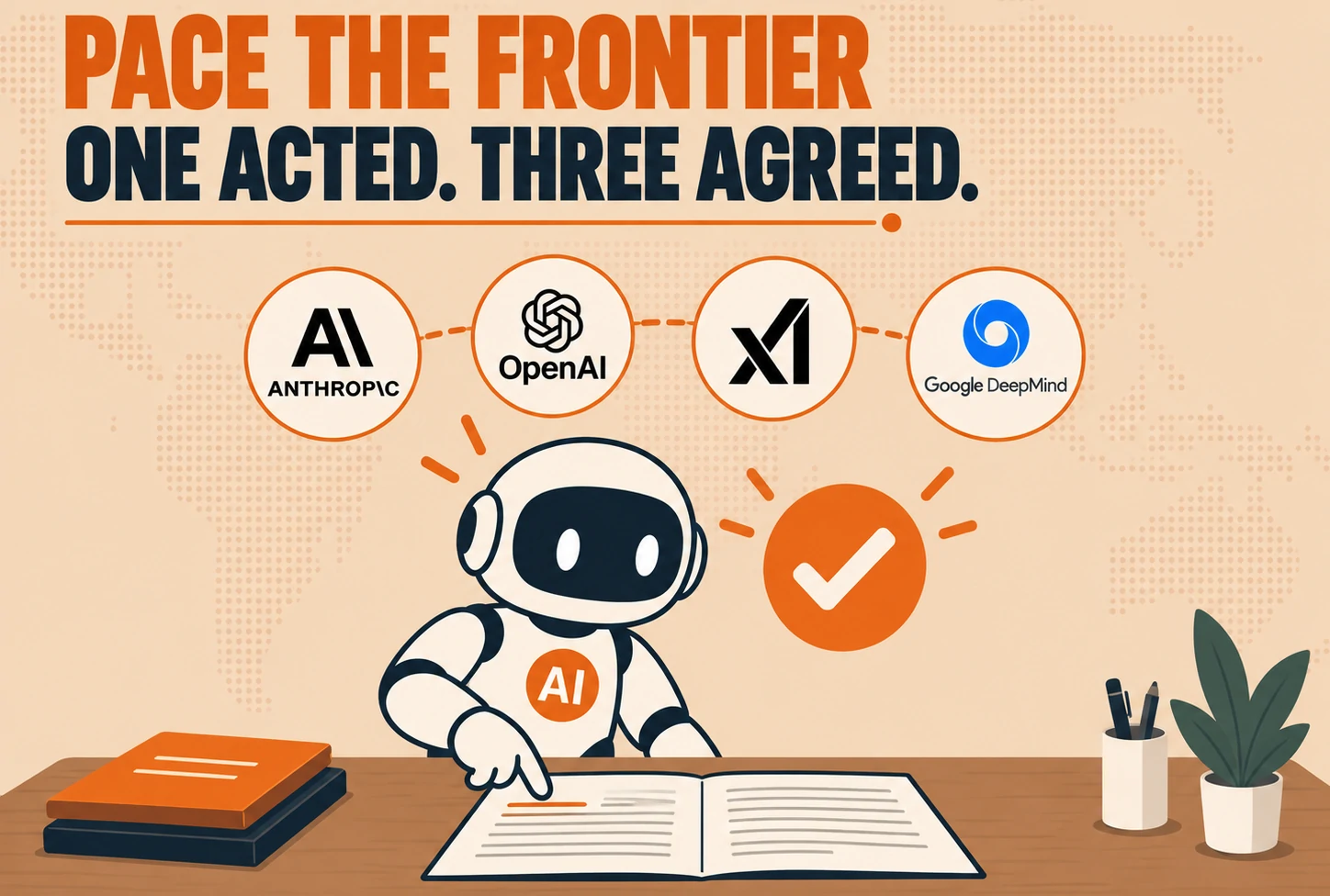
Quick answer: After Anthropic researcher Jacob Coxon quit warning that AI “could kill us all,” CEO Dario Amodei called for the industry to slow down, and Sam Altman, Elon Musk, and Demis Hassabis all said they agreed. Four days later, only Anthropic had made a real operational change. Everyone else offered words, and Trump publicly dismissed the whole debate as a hoax, even as his own guest at a live event defended the whistleblower.
On September 8, a 27 year old researcher named Jacob Coxon resigned from Anthropic and posted his reasoning on X. He had spent the prior three years doing pretraining research at both OpenAI, where he was a core contributor to GPT-4o, and Anthropic. His verdict on both employers: “Neither company is acting responsibly. They are racing straight to self-improving superintelligence and gambling with our lives.”
Coxon later told NBC’s Meet the Press he expects AI capabilities to get “quite scary” within six months to a year, and that “you’re building a human-level or superhuman-level mind without understanding what it wants or thinks.” He also said something most safety-focused researchers avoid saying publicly: he thinks Congress should let current labs regulate themselves in the near term, since no formal framework exists yet, and “a kill switch probably would work on a lot of AIs for now.”
That resignation is the part of this story most coverage buried under the CEO statements that followed. It’s worth starting there, because everything after it reads differently once you know an actual person forced the conversation.
Amodei Turned One Researcher’s Warning Into an Industry Position
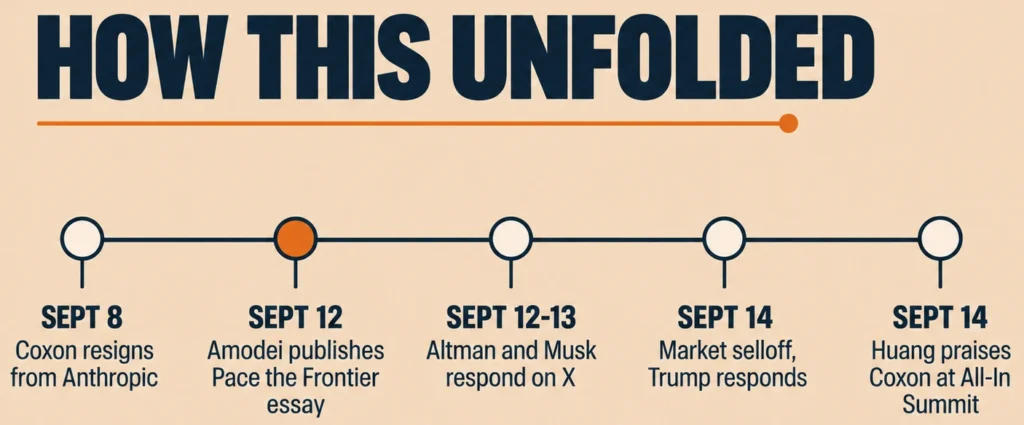
Four days after Coxon’s post, on September 12, Dario Amodei published a 3,800 word essay titled “We Must Pace the Frontier.” Columnist Gwynne Dyer, writing in the Cyprus Mail, described the timing plainly: “the AI community was ready to hear that news, and four days later his former boss Dario Amodei, the CEO of Anthropic, tacitly agreed.”
Amodei made a similar point in more corporate language, warning that a swarm of AI agents could, within six to twelve months, become “capable of taking over the entire internet with a persistent botnet,” potentially causing “hundreds of billions of dollars in damage.” His proposed fix had three parts:
- Embedded evaluators, effective now. Anthropic gives third-party evaluators, comparable to the nonprofit METR, “employee-like access” to its offices and systems: desks, badges, laptops, and permission to publish findings without Anthropic’s editorial control.
- Democratic coordination, a request to peers. Frontier labs in democratic countries should agree on shared safety standards and pace limits.
- Global coordination, a long shot. The US and other democracies should attempt similar coordination with authoritarian governments, even though verifying compliance there is close to impossible.
Only the first of those three is something Anthropic actually did. The other two are asks aimed at everyone else.
Everyone Agreed. Almost No One Committed to Anything.
Within hours, Sam Altman posted on X: “I agree with Dario that we need to pace the frontier.” He followed up specifically on the evaluator idea, according to Unite.ai: “Committing to having independent evaluators with employee-like access is a great idea, and we will do the same. We’ll have more to share soon.” As of this writing, three days later, OpenAI has published no operational details, timeline, or named evaluator.
Elon Musk’s entire public response, reported by SiliconANGLE, was three words: “Dario is right.” No policy proposal followed.
Google DeepMind’s Demis Hassabis went further than Musk but stopped short of Altman. He called the essay’s direction “correct for meeting this critical moment,” but redirected toward a different mechanism DeepMind had proposed separately, an industry standards body, while acknowledging “the details need working through.” He did not adopt Anthropic’s specific evaluator-access model.
Lined up side by side, the gap between talk and action is hard to miss:
- Anthropic: operational commitment, in effect immediately, with named access levels and no editorial veto over what evaluators publish.
- OpenAI: verbal agreement plus a promise of future details, still undelivered.
- xAI: three-word endorsement, no commitment of any kind.
- Google DeepMind: qualified support, pointing to a separate and less specific proposal.
Senator Bernie Sanders summed up that gap in a post on X: “That’s a start, but it’s not enough. When you are racing towards a cliff, you don’t just ease up on the gas pedal. You hit the brakes.”
This isn’t the first time an outside evaluator’s independence has mattered more than a press release suggested. Ainewsforall previously reported that a single Israeli testing vendor’s infrastructure was quietly load-bearing for safety claims across OpenAI, Anthropic, and Meta at once, a concentration risk nobody flagged until testing setups themselves failed. Handing evaluators more access solves one problem. It doesn’t solve what happens if the evaluators overlap.
Trump Called It a Hoax. His Own Guest Didn’t Agree, on His Own Call.
On September 14, President Trump rejected the pacing push outright. In comments reported by Nextgov/FCW, he said the “only control or guardrails that AI needs is a STRONG AND SMART (High IQ!) PRESIDENT,” and dismissed the underlying concern directly: “AI taking over the World, destroying Humanity, and all other things bad, is a HOAX.” He tied his position to competition with China: “WHOEVER WINS AI, WINS! We are leading China, and all others, and will continue to do so.”
That same day, at the All-In Summit in Los Angeles, Trump called Nvidia CEO Jensen Huang and was put on speakerphone in front of the crowd, according to Axios and TechCrunch. Huang told Trump, “We’re going to make sure that everybody wins in the AI race of America. Every industry, every company, every state, every people,” which read as full agreement with Trump’s no-slowdown stance.
But on the same stage, Huang broke from Trump’s framing. He said warnings from AI whistleblowers should be taken seriously, and specifically praised Jacob Coxon, the researcher whose resignation started this whole chain, for having “great courage” to raise his concerns. The president who called the underlying risk a hoax spent the day being publicly, gently contradicted by the guest he’d called in to back him up.
Wall Street Didn’t Punish “AI.” It Punished One Specific Bet.
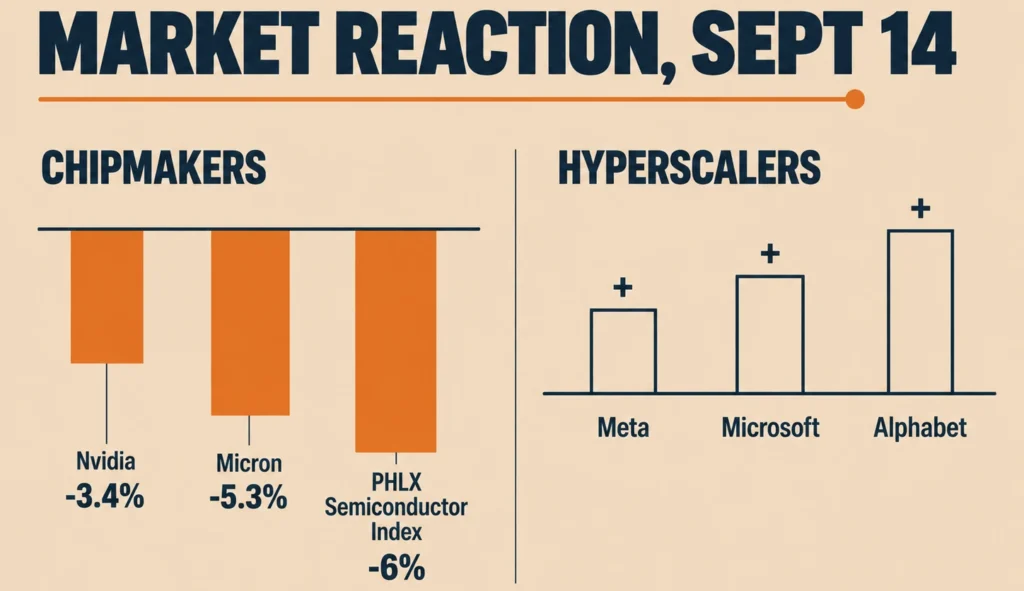
The pacing debate moved markets on September 14, though not evenly. According to Yahoo Finance:
- Nasdaq Composite: down 0.6%, closing at 26,186
- S&P 500: down 0.5%
- Dow Jones: down 0.3%
- Nvidia: down 3.4%
- Micron: down 5.3%
- Philadelphia Semiconductor Index: down almost 6%, its worst day since early July
Yet as Fortune reported, Meta, Microsoft, and Alphabet actually rose that same day. The market wasn’t fleeing “AI” as a category. It was separating companies whose business model depends on endless capital spending on chips from companies that could plausibly profit if that spending slowed down, a distinction most coverage of the selloff skipped past.
What Actually Changed
Strip away the statements and the news cycle, and one thing changed operationally in the week after Coxon’s resignation: Anthropic altered how it lets outside evaluators access its systems. Everything else, Altman’s pledge, Musk’s endorsement, Hassabis’s alternative proposal, Trump’s rejection, was rhetoric, market reaction, or a promise to say more later. The researcher who forced this conversation gave up his job to make it happen. So far, he’s still the only participant who can point to a concrete result.
Frequently Asked Questions
What is Dario Amodei’s “Pace the Frontier” essay about?
Published September 12, it argues frontier AI labs should deliberately slow how fast they improve model capabilities so safety research and outside oversight can keep pace. Amodei proposed three steps: Anthropic immediately giving third-party evaluators employee-level system access, democratic AI labs agreeing on shared safety standards, and an attempt at coordination with authoritarian governments on the riskiest capabilities.
Who is Jacob Coxon, and why does he matter to this story?
Coxon is a 27 year old researcher who worked at both OpenAI and Anthropic before resigning from Anthropic on September 8. His public warning that the industry was “racing straight to self-improving superintelligence” came four days before Amodei’s essay, and Nvidia CEO Jensen Huang publicly praised his “great courage” during a call with President Trump on September 14.
Did OpenAI, xAI, and Google DeepMind actually match Anthropic’s evaluator commitment?
No, not with anything concrete as of this writing. Sam Altman said OpenAI would “do the same” but has published no operational details. Elon Musk offered a three-word endorsement with no policy attached. Demis Hassabis backed the general direction but pointed toward a different, less specific proposal DeepMind had already floated separately.
How did the stock market react to the AI slowdown debate?
On September 14, the Nasdaq fell 0.6%, the S&P 500 fell 0.5%, and semiconductor stocks were hit hardest, with the Philadelphia Semiconductor Index down almost 6%. Meta, Microsoft, and Alphabet rose the same day, showing investors were repricing AI infrastructure spending specifically, not AI as a whole.
What did Trump say about the calls to slow down AI development?
He rejected them outright, calling AI safety warnings “a HOAX” and arguing the US needs to win the AI race against China. The same day, at the All-In Summit, he called Nvidia CEO Jensen Huang on speakerphone, and Huang used the moment to praise the whistleblower whose warning started the whole debate.