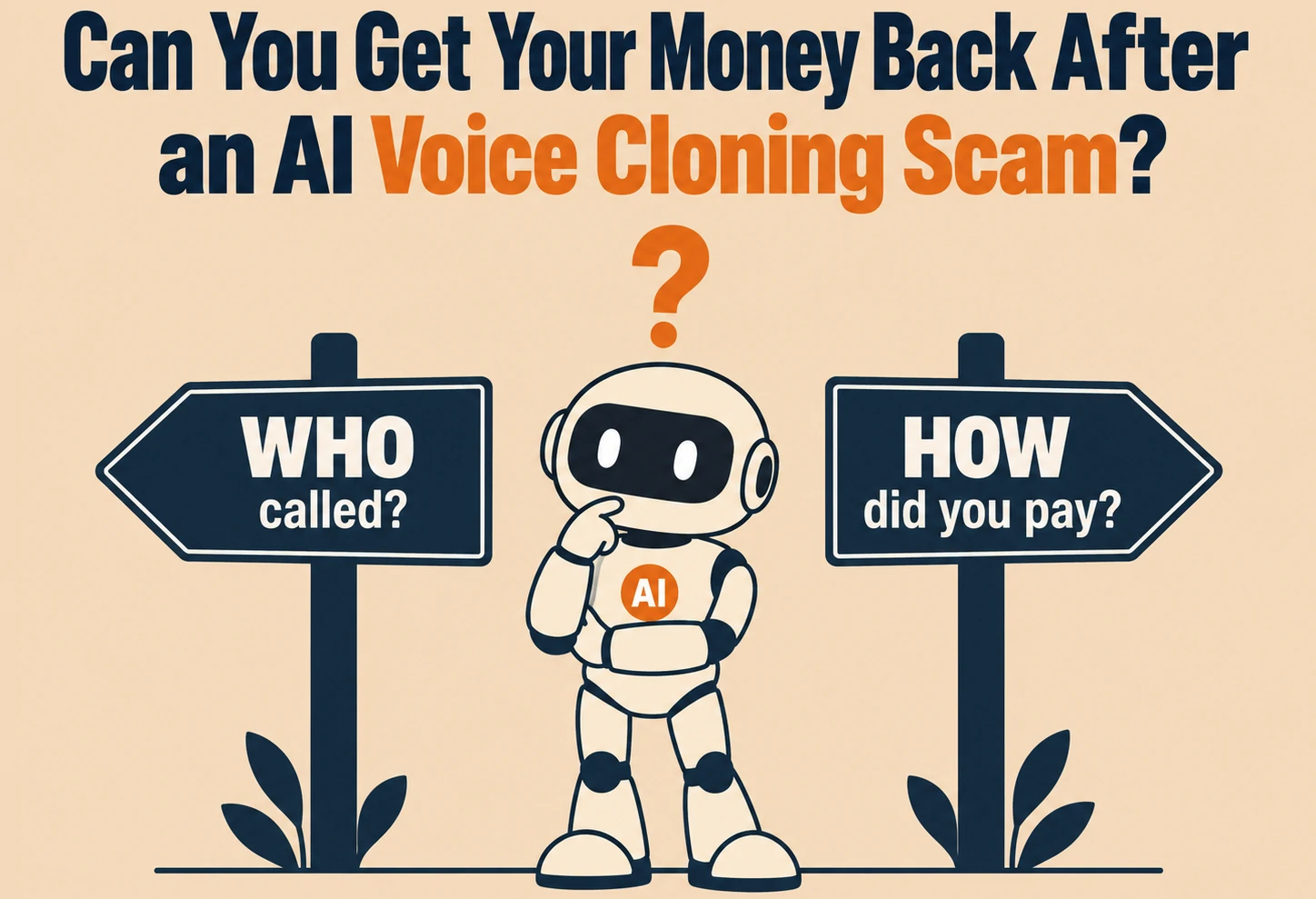
Getting your money back after an AI voice cloning scam depends on two separate questions almost nobody realizes are connected: how you paid, and exactly who the scammer claimed to be. Get the second question wrong and it doesn’t matter how fast you call your bank, the one legal protection built for this kind of fraud may not even apply to you.
That gap became painfully real for Brian and Wendy VanDoeselaar, a Michigan couple in the final stages of buying a $460,000 condo near Grand Rapids. On May 19, 2026, days before closing, they got an email demanding they wire $66,026.92 within 24 hours to cover closing costs. The email came from a domain one letter off from their real loan officer’s, “UnitedsMortgages” instead of “UnitedMortgage”, and a follow-up call came from a number differing from their loan officer’s by only the last two digits. The voice on the line sounded exactly like him. They wired the money. It was gone. Real estate scams like this cost victims more than $275 million last year, a 58.5 percent increase over 2024, according to the FBI, and CertifID co-founder Tyler Adams, whose company is now helping the couple and federal investigators try to recover the funds, says diverted money becomes nearly impossible to recover after 48 hours.
The Question Nobody Tells You to Ask First
Before checking your payment method, ask one thing: did the scammer claim to be your bank itself, or someone else entirely, a loan officer, a relative, a coworker, a company? That single distinction decides which of two completely different recovery paths applies to you, and almost nobody realizes the decision point exists until it’s already too late to matter.
Why: The One Real Legal Fix Was Built for the Wrong Threat
In 2023, under pressure from the Consumer Financial Protection Bureau, major banks agreed to reimburse a specific category of Zelle fraud: cases where the scammer impersonated the victim’s own bank’s fraud department. Before that, Regulation E let banks deny almost any claim by calling the transfer “authorized,” since the customer technically approved it themselves, even under deception. The 2023 fix closed that gap, but only for one specific script: someone pretending to be your bank.
AI voice cloning didn’t exist at meaningful scale when that rule was written, and it isn’t being used to run that script. Every documented case I’ve found, the VanDoeselaars’ loan officer, the classic “grandchild in trouble” family emergency calls, CEO wire-fraud attempts, involves cloning someone the victim already trusts who is not the bank. That means the strongest consumer protection built specifically for scam-driven bank transfers was designed around a threat model AI voice cloning has already made obsolete. It isn’t a loophole anyone is exploiting on purpose. It’s a rule written for yesterday’s version of this fraud, sitting unrevised while the technology moved to a version it was never built to catch.
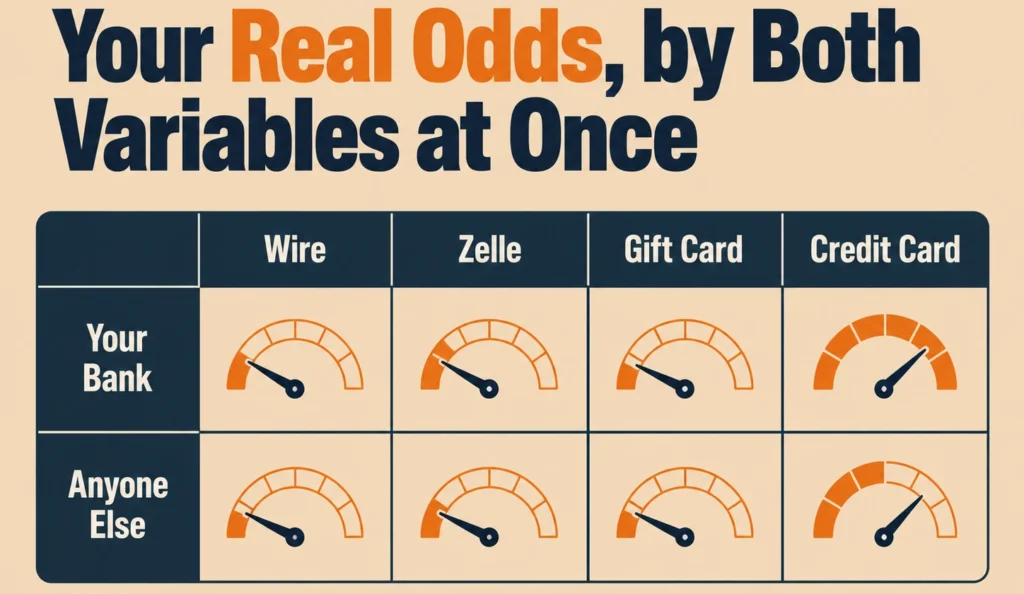
Your Real Odds, by Both Variables at Once
| Who was impersonated | Wire transfer | Zelle | Gift card | Credit card |
|---|---|---|---|---|
| Your own bank’s fraud department | Still very low, wires clear fast regardless | Reimbursement likely under the 2023 exception | Low, but a fast retailer call can still freeze it | High, dispute as unauthorized where applicable |
| Anyone else (loan officer, relative, employer, vendor) | Very low | Not covered by the 2023 exception, recovery is discretionary at best | Low, but a fast retailer call can still freeze it | Highest odds of the group, chargeback doesn’t depend on who was impersonated |
Read across a row, not down a column, and the picture most guides give you, just optimize your payment method, is incomplete. The credit card column is the one place where impersonation target barely matters: a chargeback dispute doesn’t ask who you thought you were paying, only whether the charge was authorized in a way you can contest.
What This Predicts, Not Just Describes
Two things are moving in opposite directions from each other right now, and neither is good news for AI voice clone victims specifically:
- Consumer banking protection is standing still. The 2023 Zelle fix hasn’t been updated to cover impersonation of anyone besides the bank itself, even as AI-driven impersonation of loan officers, relatives, and employers keeps growing.
- Insurance coverage is actively narrowing. Some carriers have started rewriting 2025 and 2026 policy language to explicitly exclude AI-generated impersonation from social engineering coverage, on top of the “voluntary parting” exclusion that already lets most cyber policies deny these claims. One engineering firm lost $874,863 to a cloned-voice wire fraud attempt and recovered only $250,000, its policy’s sublimit, leaving $624,000 permanently unfunded.
If this pattern holds, expect the gap to widen before regulators catch up, not narrow. The legal fix that exists is scoped too narrowly to help most AI voice clone victims, and the insurance products that might otherwise fill that gap are actively shrinking at the same time AI cloning cases are rising 58.5 percent year over year. That’s not a static problem, it’s one getting worse on both sides at once.
What to Do in the First 48 Hours
- Note immediately who the caller claimed to be. This single detail determines which recovery path applies before you even call your bank.
- If it was a wire transfer, ask about a recall request right away. CertifID’s Tyler Adams says diverted funds become nearly impossible to recover after 48 hours as they move through mule accounts, crypto, or overseas banks.
- If it was a gift card, call the retailer’s fraud line directly and ask them to freeze the balance before it’s redeemed.
- File a report with the FBI’s Internet Crime Complaint Center at ic3.gov, the way the VanDoeselaars did, since it adds official weight to any bank dispute.
- If your bank denies a claim you believe should qualify under the 2023 exception, request a written explanation citing the specific policy, then escalate to the CFPB.
How Little Audio It Actually Takes
In the VanDoeselaar case, CertifID’s Tyler Adams believes scammers pulled snippets of the loan officer’s voice from his own social media posts to clone it, using tools he says can cost as little as five dollars and take only minutes. That’s a fundamentally different attack surface than hacking an account: no break-in is required, just a public post the scammer can download.
How to Tell a Real Call From a Cloned One
- Never act on wiring instructions received only by email, text, or voicemail, the National Association of Realtors flags this as the single most common failure point.
- Call back on a number you already have saved, never one provided in the message itself.
- Confirm through more than one channel before sending anything, a text plus a callback beats either alone.
- Treat urgency itself as a warning sign. The VanDoeselaars later said the fabricated 24-hour deadline was exactly what stopped them from stepping back to question what was happening.
- Agree on a private code word with close family or colleagues in advance, something a scammer would have no way to know, for personal calls specifically.
Frequently Asked Questions
Can you get your money back after an AI voice cloning scam?
It depends on two things: how you paid, and who the scammer claimed to be. Credit card payments have the best odds regardless, through a chargeback. Wire transfers and cryptocurrency are nearly impossible to reverse either way. Zelle only has a legal reimbursement path if the scammer impersonated your bank’s own fraud department specifically.
Why doesn’t Zelle’s 2023 fraud protection cover most AI voice cloning cases?
The 2023 policy change only requires reimbursement when a scammer impersonated your bank’s own fraud department. AI voice cloning is mostly used to impersonate someone else entirely, a loan officer, a relative, an employer, which falls outside that specific exception.
Does insurance cover AI voice cloning scams?
Usually not. Individuals typically have no applicable policy at all, and business cyber insurance often denies these claims under a “voluntary parting” exclusion, since the victim authorized the payment themselves rather than being hacked. Some insurers are now writing even narrower AI-specific exclusions.
How long do I have to recover money sent to a scammer?
It’s a matter of hours, not days. CertifID co-founder Tyler Adams says diverted funds become nearly impossible to recover after 48 hours, and wire transfer reversal specifically is realistic mainly in the first few minutes after sending.
What should I do immediately after realizing I’ve been scammed by an AI voice clone?
Note exactly who the caller claimed to be, then contact your bank or card issuer immediately and report the incident to the FBI’s Internet Crime Complaint Center at ic3.gov.
How much audio does it take to clone someone’s voice?
Investigators in one 2026 case believe scammers cloned a real estate loan officer’s voice using snippets pulled from his own social media posts, with tools that can cost as little as a few dollars.
Are gift card scam victims ever able to get refunds?
Sometimes, but only if they act within hours. Contacting the retailer’s fraud line before the card balance is redeemed is the only realistic path to freezing the funds.
How can I tell if a phone call is really an AI voice clone?
Never act on wiring instructions received only by email, text, or voicemail. Call back on a number you already have saved, verify through more than one channel, and treat any artificial deadline as a warning sign rather than a reason to rush.