Nomajor AI company has confirmed reading an online store’s llms.txt file, and the real usage data backs that up. In a 90-day experiment on one real site, only about 0.1% of AI bot visits ever touched its llms.txt file, and a separate analysis of more than 137,000 domains found that 97% of llms.txt files receive zero traffic at all. Google’s John Mueller has said directly that no AI system currently uses it. Setting one up won’t hurt anything, but the evidence so far says it won’t change much either.
What an llms.txt File Actually Is
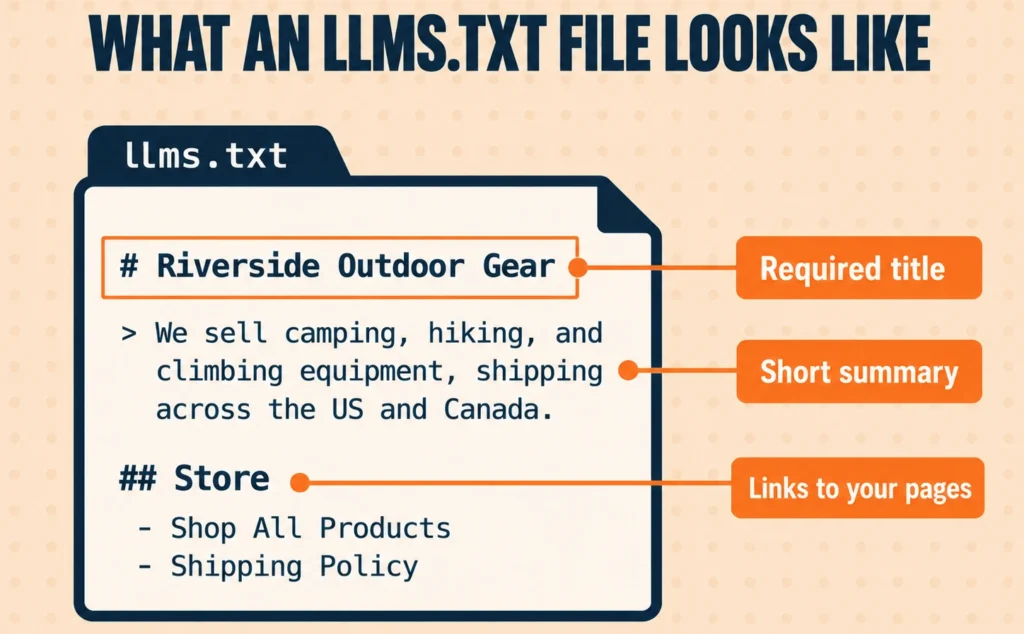
llms.txt is a Markdown file placed at a site’s root, proposed by Jeremy Howard of Answer.AI and fast.ai on September 3, 2024. The real spec is simple: an H1 with your site’s name is the only required section, followed by a short blockquote summary, then optional H2 sections listing links to your most important pages in [name](url) format with a short note after each one. A real example for an online store might look like this:
# Riverside Outdoor Gear

> We sell camping, hiking, and climbing equipment, shipping across the US and Canada.

## Store
- [Shop All Products](https://riversideoutdoor.com/shop): Full catalog of camping and climbing gear
- [Shipping Policy](https://riversideoutdoor.com/shipping): Rates and delivery timelines by region
- [Returns](https://riversideoutdoor.com/returns): 30-day return window on unused items

## Optional
- [Blog](https://riversideoutdoor.com/blog): Gear guides and trip reports
There’s also a related variant, llms-full.txt, which inlines the full text of each linked page directly into one file instead of just linking out, intended for cases where an AI system can’t or won’t crawl the linked pages separately.
Who Actually Supports Reading It?
Nobody has confirmed it clearly, and the honest picture looks different depending on who you ask.
| Who | What they’ve actually done |
|---|---|
| Mueller states directly that no AI system currently uses llms.txt. Google removed its own copy from its developer docs after clarifying it wasn’t an endorsement. | |
| OpenAI, Anthropic, Gemini | Each has published an llms.txt file for its own developer documentation, but that shows they’re experimenting with publishing the format, not that their models read it elsewhere. |
| Documentation and CMS platforms | Yoast SEO, AIOSEO, Wix, Mintlify, and GitBook can generate the file automatically, confirming real tooling support exists even without confirmed AI-side reading. |
| Coding agent tools | The most consistent confirmed use case, agents like the server-llm-txt MCP server can fetch and search llms.txt files when a developer specifically configures that. |
What the Real Usage Data Shows
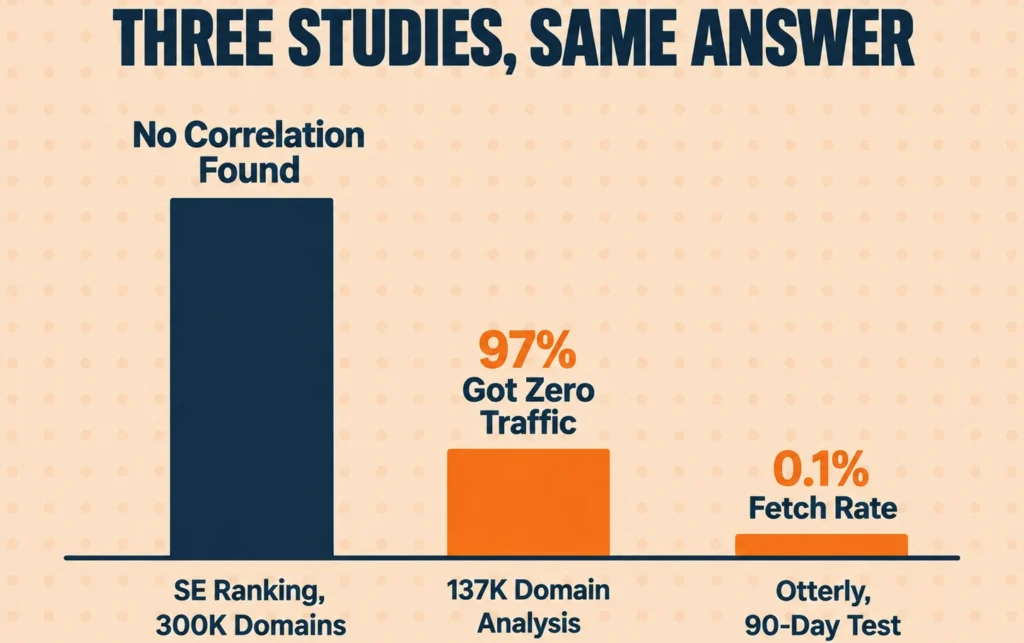
Three separate, independent checks all land on the same conclusion. SE Ranking analyzed roughly 300,000 domains and found no measurable correlation between having an llms.txt file and how often a domain gets cited in AI answers, removing the llms.txt variable from their prediction model actually improved its accuracy, meaning it was behaving as noise rather than a real signal. A separate analysis of over 137,000 domains found that 97% of the llms.txt files it checked received zero requests. And Otterly ran a 90-day, single-site experiment tracking roughly 62,100 total AI bot visits, only 84 of them, about 0.1%, ever targeted the llms.txt file, compared to roughly 265 visits to an average content page on the same site. Worth being upfront that several of these sources are SEO vendors with a commercial interest in this topic, and none of this is peer-reviewed research.
Why Google Removed Its Own llms.txt File
When people noticed Google’s own domains were serving an llms.txt file, Mueller clarified that it wasn’t an endorsement of the format at all, the file had been added for unrelated reasons, and Google’s Search team subsequently removed it from its own developer docs. On a podcast appearance, he called the file a “self-declared pitch,” arguing that an LLM system has no real reason to trust a site’s own claims about itself when it can just crawl the site directly and check, and he pointed to an emerging alternative called WebMCP as a more promising direction instead.
One Real Case Where It Might Actually Help
Most of the practical discussion around this file, including a long Reddit thread full of SEO practitioners calling it “a complete waste of time,” lands on general skepticism. But one specific, genuinely practical use case came up repeatedly among experienced commenters: if your store exposes an API or other structured service, a well-formed llms.txt can give an AI system easily parsed instructions it might otherwise struggle to extract from minified or deeply nested page content. That’s narrower than the “better AI visibility for your whole store” pitch most generators are selling, but it’s a real, specific scenario where the file could do something useful.
Should You Add One Anyway?
Probably, but with the right expectations. Nothing about setting one up is risky or expensive, it’s a small text file, so there’s little real cost to adding one as a low-priority addition rather than treating it as an urgent fix. Just don’t expect it to move any AI-visibility numbers based on what the actual data shows so far.
How to Create an llms.txt File for an Online Store
- Start with an H1 containing your store’s actual name, this is the only section the spec requires.
- Add a blockquote directly underneath with a one or two sentence summary of what your store sells.
- Add an H2 section listing links to your most important pages, product category pages, your returns policy, your shipping policy, each written as
[Page Name](https://yourstore.com/page): a short description. - Keep an optional final H2 section for secondary pages that matter less, the convention lets an AI system skip this section entirely when it needs less context.
- Upload the finished file to your store’s root directory as llms.txt, the same location as your existing robots.txt file.
- Add a noindex directive to the file itself, Mueller has suggested this specifically so the plain-text file doesn’t end up confusingly indexed and showing up in regular search results.
A Few Things Worth Knowing Before You Set One Up
- It won’t replace your actual SEO work, nothing about llms.txt affects how Google Search ranks your pages.
- It’s not inherently duplicate content either, Mueller has clarified it would only count as duplicate content if it matched an existing HTML page word for word, which defeats the point of having one.
- Treat any vendor or agency claiming guaranteed AI visibility gains from llms.txt with real skepticism, three independent usage studies so far have found essentially no measurable effect.
Frequently Asked Questions
Does Google use llms.txt files?
No. John Mueller has stated directly that no AI system currently uses llms.txt, and Google’s own Search team removed the file from its developer docs after clarifying its presence wasn’t an endorsement.
Do OpenAI, Anthropic, or Perplexity read llms.txt files?
There’s no public confirmation that any of them do. OpenAI, Anthropic, and Gemini have each published their own llms.txt files for their developer documentation, but that shows they’re experimenting with publishing the format, not that their models read it on other websites.
Does llms.txt actually improve AI visibility or citations?
The evidence so far says no. A study of roughly 300,000 domains found no measurable correlation between having the file and AI citation frequency, and a separate analysis of over 137,000 domains found 97% of llms.txt files get zero traffic.
Is an llms.txt file duplicate content?
Not inherently. Mueller has said it would only count as duplicate content if it matched an existing HTML page exactly, which wouldn’t make sense for a file meant to be a useful summary.
Is it worth adding an llms.txt file to my online store?
It’s low-risk and low-effort, so it’s reasonable to add one without expecting guaranteed results, especially if your store also exposes an API or structured service where the format can genuinely help. For a typical storefront, the usage data suggests it won’t move much.
What’s the difference between llms.txt and llms-full.txt?
llms.txt links out to your pages with short descriptions. llms-full.txt inlines the full text of each page directly into one file, meant for cases where an AI system can’t or won’t crawl the linked pages separately.