Adobe’s 2025 Creators’ Toolkit Report found that 86% of creators now regularly use generative AI — and 76% say it has directly accelerated the growth of their business. That didn’t happen because AI replaced human creativity. It happened because smart creators figured out how to use AI to create digital products faster, sharper, and more profitably than before.
If you’ve been circling the idea of building a digital product business — or you’ve started and feel stuck — the process is more accessible than most people realize. You don’t need to code. You don’t need a design degree. You need a clear workflow, the right tools, and enough domain knowledge to guide AI toward something genuinely useful.
Here’s exactly what that looks like: what to build, how to build it, what tools actually work, and what the legal situation means for your business.
What Counts as an AI Digital Product?
A digital product is any intangible item sold and delivered online — no physical inventory, no shipping, no restocking. What makes it “AI-assisted” isn’t that a machine wrote the whole thing. It’s that AI handled the heavy lifting on research, drafting, design, or ideation, while a human directed the process, added expertise, and shaped the final result.
That distinction matters — not just legally, but commercially. The products that actually sell aren’t raw AI output. They’re products where a human understood a specific audience’s problem and used AI to solve it faster than they could alone.
The digital products market generated over $124 billion in 2025, and AI-assisted creation is a fast-growing piece of that. Meanwhile, the global e-learning market alone — one of the top digital product categories — stood at $299 billion in 2024 and is projected to reach $842 billion by 2030 at a 19% annual growth rate. These aren’t theoretical numbers. They’re the market you’d be entering.
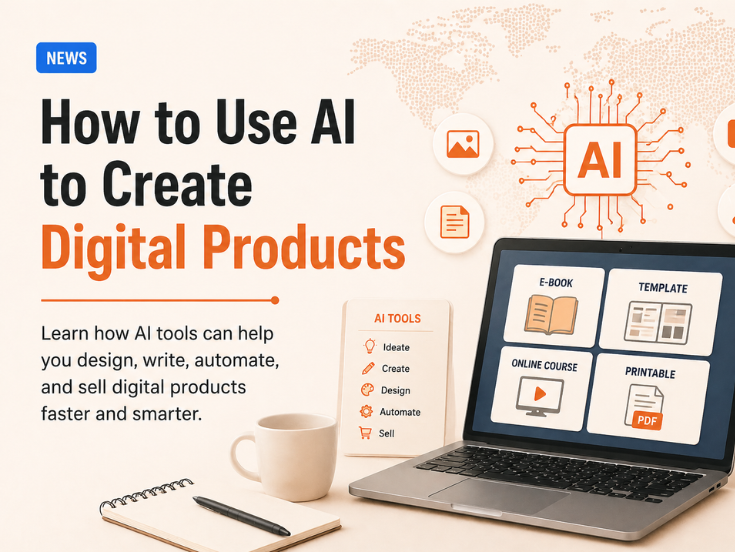
7 Types of Digital Products You Can Create With AI
1. eBooks and Guides
eBooks remain one of the most accessible digital products to build, and AI has compressed what used to take weeks into a matter of days. Use ChatGPT or Claude to generate a chapter-by-chapter outline, draft each section, fact-check the output, and layer in your own expertise.
The key is specificity. A 20-page guide called The Freelance Copywriter’s Rate Negotiation Playbook outperforms a 150-page generic business guide every time. Narrow topics with a clear outcome command higher prices and better reviews — buyers know exactly what problem it solves.
2. Online Courses and Email Courses
Teachable reported over 2 million AI-generated course elements created on its platform in 2024. That number tells you where the market is moving.
AI can draft lesson scripts, quiz questions, discussion prompts, and slide outlines. What it can’t replace is the lived experience and domain expertise you bring. Your job is to prompt AI with the right context, review critically, and fill gaps with knowledge that only comes from having actually done the thing you’re teaching.
Email courses educational content delivered over 5–10 emails — are an underused format worth noting. They’re faster to build than video courses, convert well as low-ticket entry products, and require no video equipment or editing software.
3. Templates and Workbooks
Templates consistently rank among the fastest-selling digital products because the value is immediate and obvious. A buyer doesn’t need to imagine how they’ll use it — they can see it and put it to work the same day.
AI is excellent at helping you structure templates: social media content calendars, business plan frameworks, client onboarding checklists, goal-setting workbooks. You generate the structure with AI, then customize based on what you actually know about how the end user thinks and works.
4. AI-Generated Art and Design Assets
Using Midjourney, Adobe Firefly, or DALL·E 3, creators are generating printable wall art, digital illustrations, pattern assets, and brand graphics at scale.
Midjourney is the strongest choice for artistically coherent, high-fidelity visuals — especially if you want a distinctive aesthetic. Adobe Firefly integrates directly into Creative Cloud, making it practical for anyone already working in Photoshop or Illustrator. DALL·E 3 (built into ChatGPT) is the most prompt-accurate option for specific, instruction-heavy image requests.
5. AI Prompt Packs
Prompt packs have become a legitimate product category with real buyers. A curated collection of 50–100 high-quality prompts for a specific use case marketing copy, LinkedIn posts, client proposals, real estate descriptions saves buyers hours every week.
Pricing ranges from $15 for a starter pack to $99+ for specialized, industry-specific collections. The value isn’t in the prompts themselves anyone can write a basic prompt. The value is in curation, testing, and packaging prompts around a specific workflow someone actually uses daily.
6. Coloring Pages and Printables
Coloring pages are among the fastest AI digital products to take from idea to listing. Generate black-and-white line art in a chosen niche using an AI image tool, compile into a PDF, and list on Etsy or Amazon KDP.
The niche is everything here. “Coloring pages” is a commodity. “Cottagecore mushroom forest coloring pages for adults” is a product with a clear buyer in mind. The more specific the angle, the less competition and the easier the sell.
7. Notion Templates and Productivity Systems
Notion templates have a strong buyer base among knowledge workers, freelancers, and small business owners who want systems they don’t have to build from scratch. AI can help design database structures, create linked property types, write template documentation, and build out full business operating systems.
On Gumroad, Notion templates range from $5 for a simple tracker to $150+ for full business systems. One creator documented $15,000 in Gumroad digital product sales in 2025 — with templates making up a substantial portion.
The AI Digital Product Creation Workflow (Step-by-Step)
Step 1: Validate Before You Build
The most common mistake is building a product nobody asked for. Before you open ChatGPT, spend 30 minutes on market research. Search your product idea on Etsy, Gumroad, and Amazon. Are people buying similar products? How many reviews do the top sellers have? What do buyers complain about in negative reviews — those complaints are your opportunity. Use Google Trends to confirm search interest is stable or rising for your topic. A rising search trend is a green light. A declining one is a warning worth heeding.
Step 2: Research and Outline With AI
Once you’ve validated demand, bring AI in for the heavy intellectual lifting. Give your AI tool a clear brief: who this product is for, what problem it solves, and the format it should take.
For an eBook, prompt for a full chapter outline with subheadings and key points per section. For a template, describe the use case in detail and ask AI to design the structure. For a prompt pack, ask AI to list the most common tasks your target user does weekly — that’s your starting list. The more specific your prompt, the less editing you’ll do afterward.
Step 3: Draft and Refine
AI generates a first draft. You read it critically. Ask yourself: does this reflect what I actually know about this topic? Is anything vague, inaccurate, or generic? AI tends to produce technically correct but experientially hollow content. Your job in this pass is to inject specificity — real examples, real numbers, real context — that makes the content genuinely useful. Many creators report AI cutting the drafting and structuring phase of product creation dramatically, though the exact time saved varies by product type. What AI can’t compress is the human layer, the specificity and lived expertise, that makes the product worth buying.
Step 4: Design and Package
Canva handles 90% of what most digital product creators need: eBook covers, workbook interiors, template mockups, social graphics. No design background required. For AI art products, your image tool handles creation — Canva or Adobe Express handles layout and export. For PDF-based products, export at 300 DPI minimum if anything will be printed. For courses, record in a quiet space with decent lighting — AI wrote the script, but the delivery has to be yours.
Step 5: List, Price, and Sell
Platform selection matters. So does pricing. A $7 product and a $27 product take similar effort to create — but the $27 version earns nearly 4x the revenue per sale and often converts at comparable rates once the product page is well-written. Don’t underprice out of uncertainty. For the listing itself: use your product’s most specific benefit in the title, lead with the outcome in your description (not the features), and show mockups that help buyers visualize using it. On Etsy especially, the thumbnail image drives click-through more than the title does.
Best AI Tools for Creating Digital Products
| Tool | Best For | Price (2025) | Skill Level Needed |
|---|---|---|---|
| ChatGPT (GPT-4o) | Writing, outlining, brainstorming | Free / $20/mo Pro | Beginner |
| Claude | Long-form drafting, nuanced content | Free / $20/mo Pro | Beginner |
| Midjourney | High-quality art, illustrations | $10–$60/mo | Intermediate |
| Adobe Firefly | AI images inside Creative Cloud | Included with Adobe CC | Intermediate |
| DALL·E 3 (via ChatGPT) | Prompt-accurate image generation | Included with ChatGPT Plus | Beginner |
| Canva AI | Design, layout, branding | Free / $15/mo Pro | Beginner |
| Notion AI | Productivity templates, structured docs | $10/mo | Beginner |
| Suno AI | Music and audio creation | Free / $8/mo Pro | Beginner |
Source: Individual platform pricing pages, April 2025
Where to Sell Your AI-Created Digital Products
The platform determines your reach and your margin. Four main options:
Etsy: Best for printables, art, templates, and anything visual. Etsy’s search traffic is genuinely powerful for niche products. Fees: $0.20 per listing + 6.5% transaction fee. Best for beginners because traffic comes to you.
Gumroad: Best for guides, prompt packs, templates, and direct creator-to-audience sales. Lower fees, more flexibility, but you supply your own traffic. Fees: 10% on free plan, lower on paid plans.
Kajabi / Teachable: Best for online courses and email courses. Both handle hosting, payments, and student access in one place. Higher monthly cost, but purpose-built for educational products.
Amazon KDP: Best for low-content books: journals, coloring pages, planners, activity books. Amazon handles distribution and print-on-demand. Free to list; royalties vary by format and price point.
There’s no wrong answer the right platform is wherever your target buyer already spends time.
What You Need to Know About Copyright and Legality
This is the section most guides skip. It’s also where problems tend to start. The U.S. Copyright Office’s 2025 AI guidance is clear: purely AI-generated content — where a human provided only a prompt — is not copyrightable. Copyright protection applies when there is meaningful human creative input: editing, arrangement, selection, original additions. You can sell AI-assisted products, but you cannot claim copyright over unmodified AI output.
Two practical obligations follow:
Check your tool’s commercial use terms: Midjourney’s paid plans allow commercial use. DALL·E 3 via ChatGPT Plus grants users rights to use generated images commercially. Adobe Firefly outputs are commercially safe by design — Adobe built the model on licensed content specifically for this reason. Always verify current terms before listing; they change.
Add meaningful human input: The more you edit, customize, arrange, and add genuine expertise to your AI output, the stronger your position legally and commercially. This isn’t just legal protection. It’s what makes the product worth buying in the first place. Don’t market AI products as “handcrafted” or “100% original” if they aren’t. Beyond the legal exposure, it erodes trust the moment a buyer notices.
Frequently Asked Questions
What digital products can I create with AI?
The most common AI-assisted digital products are eBooks, online courses, email courses, printable art, templates, workbooks, Notion productivity systems, prompt packs, and low-content books like journals and coloring pages. Any product that begins with writing, design, or structured content can be meaningfully accelerated with today’s AI tools.
Can you legally sell digital products made with AI?
Yes, with conditions. Selling AI-assisted products is legal, but you must follow each tool’s commercial use terms — not all tools permit resale of outputs. Purely AI-generated work without human creative input is not copyrightable under current U.S. Copyright Office guidelines, so adding your own expertise, editing, and customization is both legally and commercially important.
What is the best AI tool for creating digital products?
For written products, ChatGPT (GPT-4o) and Claude are the strongest options. For visual products, Midjourney produces the highest artistic quality, while Adobe Firefly is the best choice for anyone already working inside the Adobe ecosystem. Canva AI handles design and packaging for most creators without requiring specialized skills.
How long does it take to create a digital product with AI?
A simple product — a short guide, a prompt pack, a printable — can be listed within a few hours. A complete online course or comprehensive template system typically takes one to four weeks even with AI handling the heavy lifting. The bulk of the time is in validation, editing, and packaging — not the initial drafting.
Can I use ChatGPT to create digital products to sell?
Yes. ChatGPT Plus (GPT-4o) grants commercial use rights for content you generate on the platform. OpenAI’s terms give you ownership of outputs — but the more you customize and build on the base output, the stronger and more differentiated your product becomes.
How do I know if my AI digital product will actually sell?
Validate before you build. Search your idea on Etsy and Gumroad — look for similar products with 50+ reviews (proof of demand) and read the negative reviews (your opening). Check Google Trends to confirm search interest is stable or rising. A product that solves a specific, named problem for a clearly defined audience will consistently outperform a generic one, regardless of how polished the AI output is.
The Advantage Window Won’t Stay Open Forever
The digital products market hit $124 billion in 2025. McKinsey estimates generative AI is already producing $2.6–$4.4 trillion in annual value across business functions globally — and product creation is one of the clearest expressions of that value for independent creators.
AI has lowered the barrier to entry enough that a first-time creator with a good idea and a few hours can produce something genuinely competitive with products that took professionals weeks to build just a couple of years ago.
But that window belongs to people who act before the baseline rises. As AI tools become standard, the products that win will be the ones where the human element is obvious — where the creator’s expertise, perspective, and audience understanding turn AI output into something that couldn’t have been generated by just anyone with a subscription.
That’s the work worth doing now. Not generating content for its own sake. Building something specific enough, sharp enough, and useful enough that the buyer feels like it was made exactly for them — because it was.