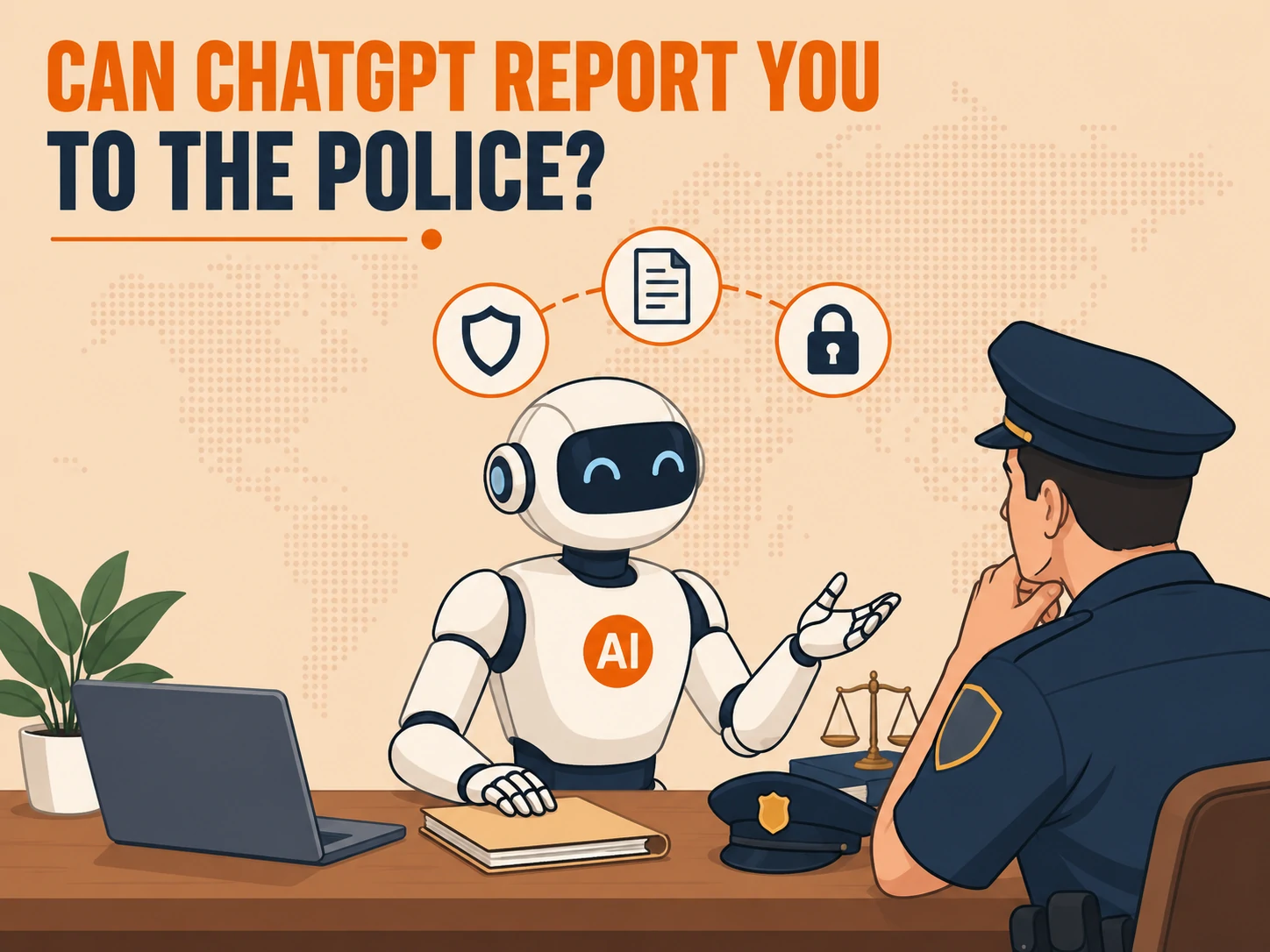
Quick answer: Yes, but only in narrow, specific circumstances. OpenAI’s human reviewers can refer a conversation to law enforcement if they determine there’s an imminent threat of serious physical harm to someone else. Self-harm conversations are explicitly not referred, to preserve privacy. Separately, OpenAI can be legally compelled to hand over your data through a warrant or subpoena, a different process entirely, and this has already happened in at least one confirmed case. Whether your employer can see your chats depends entirely on which ChatGPT plan your organization uses.
The Four Different Ways This Actually Works
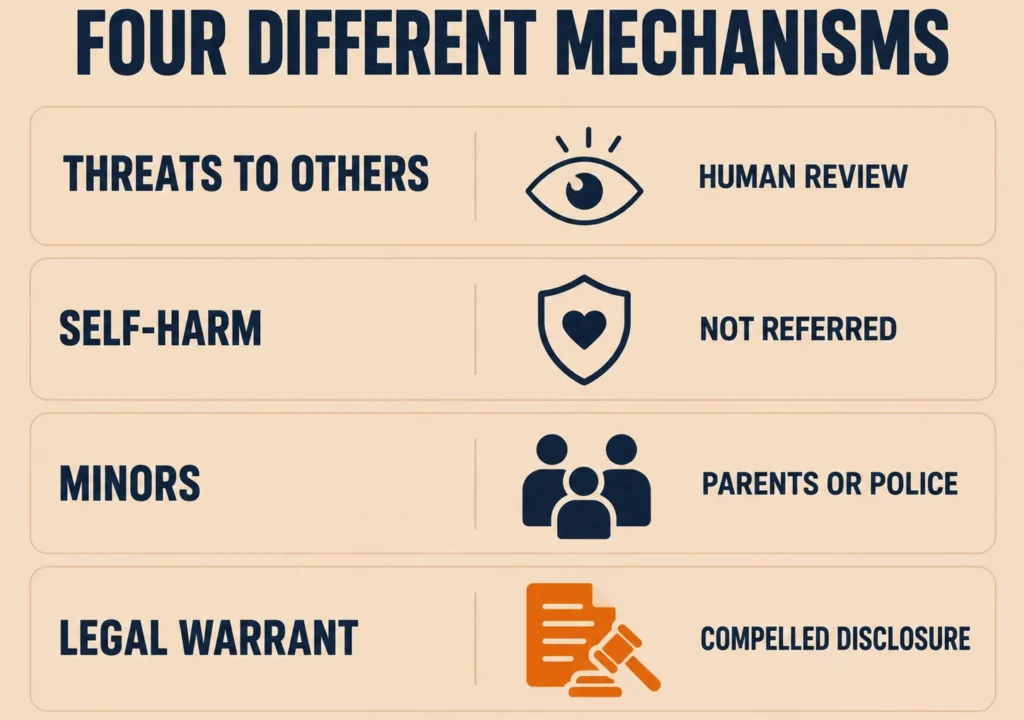
Most existing coverage treats “ChatGPT reports you to police” as one scary, undifferentiated idea. It’s actually four separate mechanisms, and they work very differently.
1. Threats to other people trigger human review, not an automatic report. OpenAI scans conversations for concerning content and routes serious cases to a specialized human review team. ChatGPT itself doesn’t call the police, a trained human reviewer decides whether a flagged conversation represents an imminent, credible threat of serious physical harm to someone else, and only then may the case be referred to law enforcement.
2. Self-harm conversations are explicitly not referred. OpenAI has stated it is “currently not referring self-harm cases to law enforcement,” specifically to respect the privacy of what it calls the “uniquely private nature” of these conversations. If you’re worried a conversation about your own mental health could get you reported, this is the direct answer: it’s the one category OpenAI has said it deliberately excludes.
3. Minors are handled differently again. Under policy changes OpenAI rolled out for underage accounts, if a minor discusses suicidal ideation in a severe enough scenario, ChatGPT will attempt to contact a parent or, in particularly serious cases, local police. This sits outside the adult self-harm exception above.
4. Legal warrants and subpoenas are a completely separate, after-the-fact process. This has nothing to do with content scanning. It’s OpenAI responding to a legal order compelling it to hand over data it already has stored.
The Real Case Behind This
Coverage of this topic has circulated a Florida case described as “a man told ChatGPT he was going to murder his wife.” The details are more specific than that. Multiple legal-press reports identify the case as a 25-year-old former Goldman Sachs analyst who told ChatGPT he planned to kill his ex-girlfriend, writing “I’m gonna kill her by the end of this month” in messages later preserved in court records. OpenAI’s review team detected the pattern and alerted the FBI in May 2026. Federal agents shared roughly two months of his messages with the Palm Beach County Sheriff’s Office. He was arrested, pleaded guilty in August 2026 to three felonies, and received eight years of probation with adjudication withheld, meaning no prison time.
Separately, in what’s reported as the first known federal search warrant specifically for ChatGPT prompts, Homeland Security Investigations obtained a warrant for a user suspected of running dark web sites hosting child sexual abuse material, after an undercover agent had already made contact with that person. OpenAI complied, providing an Excel spreadsheet with the account’s names, addresses, payment data, and conversation history. The Florida case shows the proactive detection-and-referral mechanism in action. The warrant case shows the legally compelled disclosure mechanism in action. They’re distinct processes triggered in different ways.
OpenAI’s own policy states it discloses user data only in response to valid legal process or a good-faith belief that someone faces imminent danger of death or serious injury, and it commits to notifying the affected account holder unless legally barred from doing so. In the first half of 2025, OpenAI reported receiving 119 requests for account information, 26 requests for chat content, and 1 emergency request.
What About in the Workplace?
This depends entirely on which plan your workplace uses.
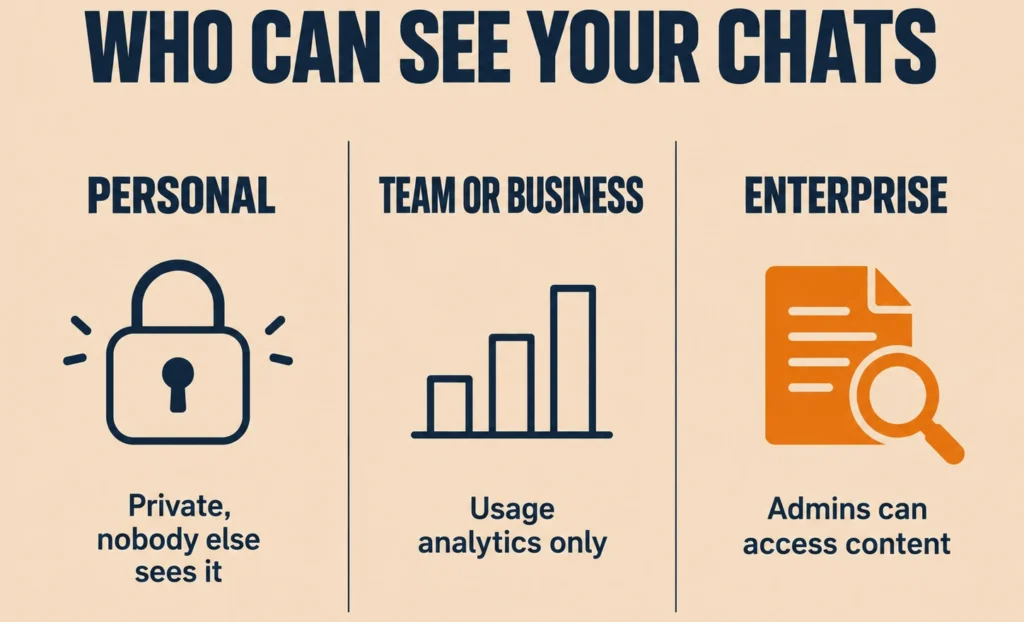
- Personal account: Only you see your own conversations. No employer visibility exists.
- ChatGPT Team or Business: Admins manage users, billing, and usage analytics, but they don’t get a console or API that surfaces individual conversation content, unless there’s active litigation, a formal investigation, or an audit underway.
- ChatGPT Enterprise, Edu, or Healthcare: Only a workspace owner, not any admin, can grant the specific “Conversation messages” permission through OpenAI’s Compliance Platform. Once granted, conversation content, uploaded files, and stored memories flow through a Compliance API built for eDiscovery, DLP, and SIEM tooling. Compliance logs are retained for 30 days by default, and OpenAI’s own documentation lists the third-party platforms this data already integrates with, including Microsoft Purview, CrowdStrike, Netskope, Varonis, Palo Alto Networks, and Zscaler.
If you’re on a personal account, none of this applies. If your workplace issued an Enterprise seat and already uses one of those security platforms, an admin with the right permission can pull your conversation content into it.
What Happens to a Chat After You Delete It?
Deleting a chat removes it from your account view immediately, and OpenAI schedules it for permanent deletion from its systems within 30 days, unless it must be retained longer for a legal hold or security reason. You cannot restore a deleted chat once it’s gone. If you have Memory turned on, deleting the conversation that created a memory does not delete the memory itself, that has to be cleared separately in Settings.
What This Means for You
- A conversation about your own mental health is handled through Trusted Contact, an opt-in feature involving someone you chose, not law enforcement.
- A conversation involving a credible threat to someone else goes through human review before any referral happens.
- Whether your employer can see your chats depends on whether you’re on a personal, Team/Business, or Enterprise seat, and on Enterprise, on whether a workspace owner has granted the specific conversation-access permission.
- Police involvement generally requires actual legal process, a warrant or subpoena tied to a real investigation, not passive monitoring of everyone’s conversations.
Frequently Asked Questions
Can ChatGPT report you to the police?
Indirectly, yes. ChatGPT itself doesn’t decide to call police. OpenAI’s human reviewers can refer a conversation to law enforcement if they determine it shows an imminent threat of serious physical harm to another person, as happened in a 2026 Florida case. Separately, OpenAI can be legally compelled to share stored data through a warrant, as happened in a confirmed case involving Homeland Security Investigations.
Does ChatGPT report self-harm conversations to police?
No. OpenAI has stated self-harm cases are not referred to law enforcement. Since May 2026, an opt-in feature called Trusted Contact can alert a friend or family member the user has nominated in advance, without sharing chat transcripts.
Does ChatGPT share your data with advertisers or other companies?
OpenAI’s policy states it does not sell user data to advertisers and does not share chat content, chat history, or personal details with them. Advertisers receive only aggregated performance data such as total views and clicks.
Can my employer see my ChatGPT conversations?
It depends on the plan. Personal accounts are private. Team and Business admins get usage analytics but not conversation content outside formal investigations. Enterprise, Edu, and Healthcare workspaces require a workspace owner to grant a specific permission before conversation content becomes accessible through the Compliance API.
What happens to a chat after I delete it?
It disappears from your account immediately and is scheduled for permanent deletion within 30 days, unless a legal or security obligation requires longer retention. Stored memories from that chat are not automatically deleted and must be cleared separately.