Is the AI Bubble Bursting? What October’s Tech Selloff Actually Shows
October's AI stock selloff had four separate causes, not one bursting bubble, and current valuations sit far below dot-com extremes.

In this article
No, not based on what actually happened in October 2026. Four of the biggest AI-linked companies moved for four different, mostly unrelated reasons that month, and conflating them into one “AI bubble bursting” narrative flattens a specific, explainable month into a scarier story than the facts support. The Nasdaq Composite fell about 5.2% for the month while the broader S&P 500 dropped only about 1.2%, so even the premise that “the market” panicked doesn’t hold, this was contained to tech, and within tech, it wasn’t even uniform.
This is also a much smaller story than China’s. On October 26, China’s STAR50 index, the country’s most AI-concentrated benchmark, fell 40% from its July peak on a real, confirmed valuation bubble. The worst-hit US stock this entire month, Intel, fell 29% for reasons that have nothing to do with AI spending. The actual US tech sector move for the whole month was about 5%. Treating these as the same kind of event, just because both involve companies with “AI” somewhere in their business, erases the difference between a confirmed bubble correction and a mixed month of earnings reactions.
What Actually Happened to Each Company, No Hedging
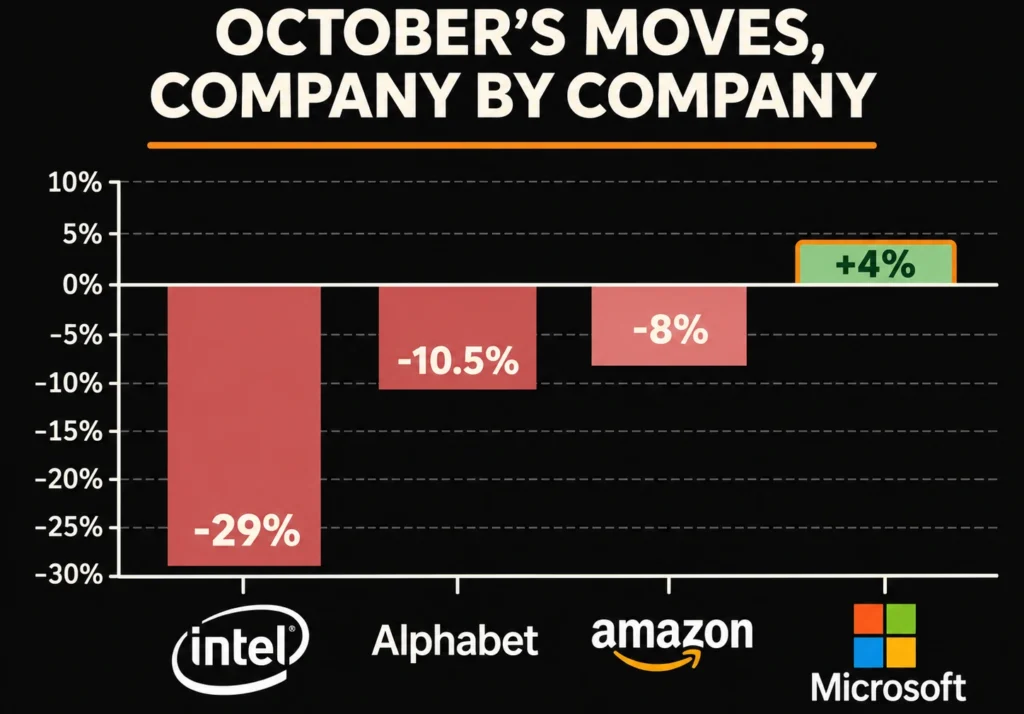
- Intel crashed 29 to 30 percent in a single day, and it has almost nothing to do with AI. The cause was weak Q4 guidance built on Intel’s own forecast of a shrinking PC market in 2027, compounded by a fatal explosion at its Kiryat Gat chip facility in Israel that disrupted production. Intel’s actual Q3 results were strong, revenue up 21%, data center sales up 78%. The stock got hit on a legacy-business forecast, not on anything related to AI spending.
- Amazon fell 6 to 10 percent on a real earnings miss, but the reaction overstated the substance. Earnings of $1.89 per share missed the $1.96 expected, and a $42.4 billion trailing-12-month free cash flow outflow spooked investors watching AI infrastructure spending. But AWS itself, the actual AI-exposed business, grew roughly in line with expectations. Deutsche Bank kept its Buy rating and called the drop a function of informal trader expectations running ahead of the real analyst consensus.
- Alphabet dropped 10 to 11.5 percent on a genuine profit miss tied to slowing search growth, its core, non-AI business. This is the one move on this list that’s arguably about company-specific competitive pressure more than AI capital spending at all.
- Microsoft rose 3 to 5 percent, and at least one circulating claim about why is simply wrong. Azure grew 48%, beating the roughly 45% analysts expected. A popular framing claimed Azure “merely met” expectations and that’s what tanked tech stocks that week, that’s backwards. Microsoft beat, and its stock went up. The only live debate is about a capex accounting change (extending data center depreciation from 15 to 25 years), a bookkeeping question, not a demand problem.
The hype coverage got ahead of these facts:
- Futurism ran with “Stock Market Bloodbath Spikes Fears of AI Bubble Bursting.”
- NBC News described a “$1 trillion” Nasdaq 100 wipeout.
- Memeburn put a $600 billion figure on two stocks in two days.
None of these pieces separate Intel’s PC-cycle problem from Amazon’s spending optics from Alphabet’s search-growth concern from Microsoft’s actual beat, they collapse four distinct corporate stories into one number because a bigger number makes a scarier headline. Four companies, four stories. One PC-cycle miss, one spending-expectations overreaction on an in-line AI business, one search-competition problem, and one actual beat that got mischaracterized as a disappointment. None of that adds up to “the AI trade is cracking.”
The Valuation Math Doesn’t Support a Bubble Comparison
Two comparisons settle this on their own:
- Earnings multiple: the Nasdaq 100 trades at a trailing P/E in the low-to-mid 30s and a forward P/E around 27 right now, versus roughly 104 to 200 times earnings at the actual dot-com peak, depending on methodology.
- Total run-up: the index is up about 140% since ChatGPT launched in November 2022, versus roughly 1,090% at the dot-com bubble’s peak in March 2000.
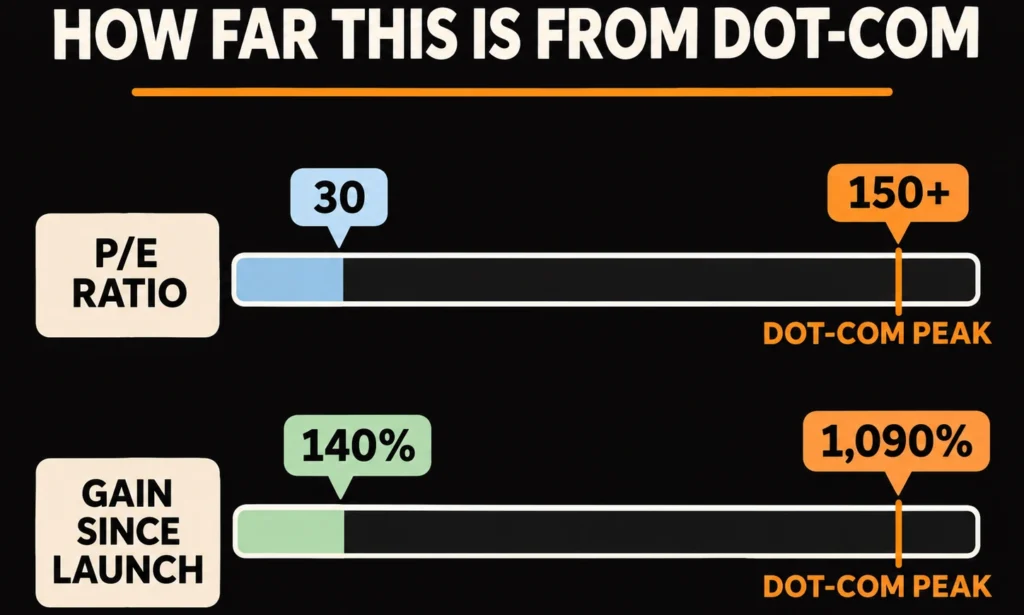
Both point the same direction: October’s drop was a real, earnings-driven repricing inside a market that is nowhere near historical bubble extremes. Calling this a bubble bursting requires ignoring the actual numbers.
The Real Tell: Anthropic Is Still Pushing a $2 Trillion IPO Through This Exact Window
Here’s the piece of evidence that settles the question better than any single earnings report. While this selloff was unfolding, Anthropic filed its S-1 on October 26 and has kept moving toward an IPO roadshow reportedly starting around November 10, with a debut targeted before Thanksgiving, at a valuation target that’s climbed to around $2 trillion, more than double the $965 billion private valuation it carried in May 2026. That would make it the largest IPO in history.
Goldman Sachs, Morgan Stanley, and J.P. Morgan are underwriting that offering, and it’s worth remembering what Anthropic’s own S-1 disclosed: a $80.7 billion net loss for the first half of 2026 alone, most of it a non-cash accounting markup tied to its own rising valuation, not cash actually burned. A company carrying a headline loss that size is choosing this exact month, in the middle of an “AI selloff” news cycle, to push for the single largest valuation any company has ever sought at IPO. That’s not the behavior of underwriters who think the growth story is cracking, it’s a bet that the market will look past a scary-looking loss number the same way this article argues it should look past a scary-looking selloff number.
What Actually Determines If This Was the Start of Something Bigger
Not October’s earnings. The real test is how Anthropic’s IPO actually prices in November:
- If it prices near or above the $2 trillion target and trades up, that confirms institutional capital still believes in the AI growth story at the highest valuations ever attempted.
- If the IPO gets delayed again, prices well below target, or trades down hard, that’s the actual signal worth treating as evidence of a genuine cooling, not this month’s mixed bag of company-specific misses.
Frequently Asked Questions
Is the AI bubble bursting?
Not based on October’s evidence. Four major tech companies moved for four different reasons, most unrelated to AI spending itself, and current valuations sit well below historical bubble levels on every major measure.
Why did Intel’s stock crash so hard?
Weak 2027 PC market guidance and a factory explosion in Israel, not AI-related spending concerns. Intel’s actual Q3 results were strong.
Did Microsoft’s stock really fall because Azure missed expectations?
No. Azure beat expectations (48% growth versus roughly 45% expected), and Microsoft’s stock rose 3 to 5 percent. A circulating claim that Azure “merely met” expectations is incorrect.
How does today’s AI valuation compare to the dot-com bubble?
The Nasdaq 100 trades at roughly 27 to 34 times earnings now, versus 104 to 200 times at the actual dot-com peak, and it’s up about 140% since ChatGPT’s 2022 launch versus roughly 1,090% at the dot-com bubble’s peak.
What’s the strongest evidence that the AI trade isn’t collapsing?
Anthropic is pushing ahead with a roughly $2 trillion IPO target during the exact month of this selloff, the largest IPO ever attempted, despite carrying an $80.7 billion headline net loss. Major banks underwriting that deal would not back a record valuation if they believed the sector was breaking down.
What should actually be watched next?
How Anthropic’s IPO prices in November. A strong pricing and aftermarket trade would confirm institutional confidence in AI valuations; a delay, a price cut, or a weak debut would be the real signal of a cooling trade.
Every number, date and quote in this article links to its source. Spotted a mistake? Tell us and we will correct it with a dated note. Read our editorial policy.