China’s AI Bubble Burst. STAR50 Lost $480 Billion in Four Months.
China AI bubble bursts as the STAR50 index fell 40 percent from its July peak, erasing $480 billion while Nasdaq slipped just 6 percent.

In this article
- What Actually Happened to China’s AI Stocks
- The Three Real Pressure Points Behind the Selloff
- The Companies That Show the Boom and Bust Up Close
- How Beijing Is Actually Responding, and It’s More Complicated Than “Rescue the Market”
- What to Watch Next
- China’s AI Bubble Burst. The Global AI Trade Hasn’t.
- What This Could Mean for the Rest of the World
- Frequently Asked Questions
China AI bubble has genuinely burst, at least in one corner of the market. The STAR50 index, home to the country’s leading AI and chip companies, has fallen 40 percent since its July peak, wiping out roughly $480 billion in value, while the broader CSI 300 has dropped into a bear market after ten straight weekly declines. That part is real and confirmed.
What hasn’t happened, at least not yet, is proof that the wider global AI spending boom is unraveling the same way. Over the same stretch, the Nasdaq’s worst pullback was about 6 percent, something Reuters called “a mere prick” next to China’s drop. STAR50 fell from valuations so extreme, nearly 250 times trailing earnings at its peak, that even after the crash it still trades around 100 times earnings, more than triple the Nasdaq 100’s roughly 30.
What Actually Happened to China’s AI Stocks
AI and chip stocks had grown to make up 42 percent of China’s total market capitalization and 57 percent of trading turnover across mainland A-shares and Hong Kong H-shares, according to Goldman Sachs data cited by Reuters. That concentration meant a huge share of ordinary Chinese investors had money riding on a narrow slice of extremely expensive companies, so when sentiment turned, the damage spread fast and wide rather than staying contained to a few names.
The Three Real Pressure Points Behind the Selloff
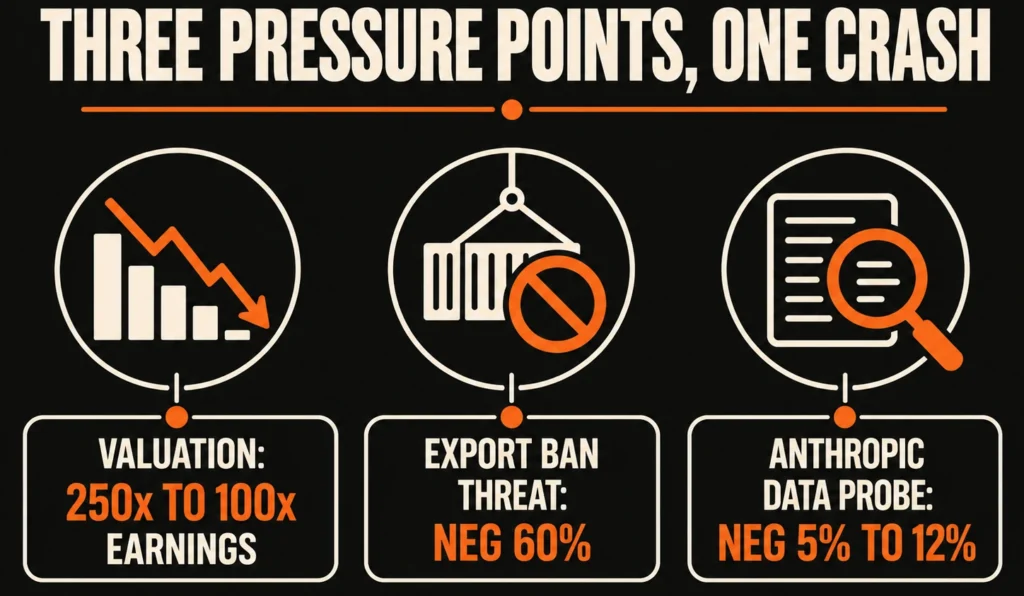
Reuters reports there was no single moment that triggered the slide. Instead, three separate pressures compounded over several months until the index cracked:
- Stretched valuations on their own terms. STAR50 had climbed to nearly 250 times trailing earnings purely on AI enthusiasm, a multiple with no real historical precedent even by past bubble standards, leaving the index fragile enough that almost any bad news could trigger a sharp repricing.
- A direct threat to actual customers, not just sentiment. Optical component makers Zhongji Innolight and Eoptolink, both major suppliers to US data centers, are down about 60 percent from their summer highs as Washington moves toward banning Chinese-made equipment from American facilities. For these two companies, this isn’t abstract fear, it’s a real risk to their largest buyers.
- A regulatory probe that traces back to Anthropic. On September 10, 2026, Anthropic published its fourth threat intelligence report, accusing seven China-based AI labs, Alibaba, Moonshot, DeepSeek, Zhipu, MiniMax, SenseTime, and Xiaomi, of what it called illicit distillation: covertly extracting Claude’s outputs at industrial scale, reportedly through networks of fraudulent accounts, to train rival models. China’s Cyberspace Administration responded by summoning representatives from all seven companies, later narrowing its formal inquiry to DeepSeek and Moonshot specifically over potential violations of China’s Data Security Law. The report landed hard: Zhipu’s Hong Kong-listed shares fell as much as 12 percent, MiniMax dropped roughly 6.8 percent, and Alibaba slid nearly 5 percent, even though Alibaba isn’t the subject of the CAC’s formal inquiry. China’s Commerce Ministry has publicly rejected Anthropic’s claims, and none of the seven labs had responded on the record as of this report.
The Companies That Show the Boom and Bust Up Close
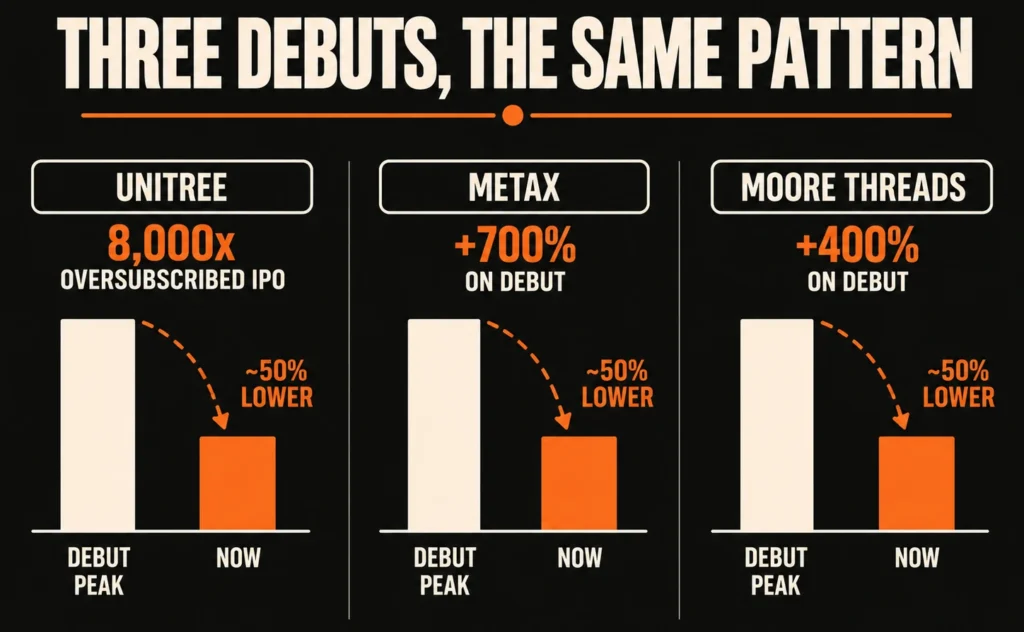
The index-level numbers are abstract. The individual companies behind them tell a clearer story:
- Unitree, a robotics maker, listed in August to such demand that retail investors oversubscribed the offering roughly 8,000 times over. Its stock has since lost about half its value.
- MetaX and Moore Threads, both chipmakers, rocketed 700 percent and 400 percent on their debuts last year, only to give back roughly half of their value since July.
- CXMT, a memory chipmaker, has lost more than a quarter of its value in the past month alone.
How Beijing Is Actually Responding, and It’s More Complicated Than “Rescue the Market”
The common shorthand for how China handles a stock selloff is that the government simply steps in and buys. The real picture this time is more layered. State-backed “national team” investors poured 128.7 billion yuan, about 19 billion dollars, into nine actively traded ETFs in the week before October 26, the largest such inflow since a nearly 140 billion yuan intervention in April 2025 during an earlier tariff-driven rout.
At the same time, Reuters reports that state-backed investors have also been acting as sellers into individual stock rallies, deliberately capping gains on specific names rather than letting them run. Put together, that’s a government trying to cushion the broad market while still actively preventing speculative mania in individual stocks, not a blanket rescue operation.
What to Watch Next
This selloff is landing right after a vivid recent precedent. Memory chipmaker CXMT listed on Shanghai’s STAR Market on July 27, 2026, closing its first day up about 466 percent and raising roughly $8.6 billion, instantly becoming the most valuable company on China’s entire A-share market. That’s the same CXMT now down more than a quarter from its highs, a reminder of how fast these valuations move in both directions.
Moonshot AI is the clearest live test of what happens next. The company confidentially filed for a roughly $3 billion Hong Kong IPO on September 3, 2026, and it’s since drawn pressure from two separate directions. Back in July, White House tech official Michael Kratsios and Treasury Secretary Scott Bessent accused Moonshot of distilling Anthropic’s Fable model and using export-banned Nvidia chips, routed through Thailand, to train its Kimi K3 model, an allegation China’s embassy in Washington called “entirely unfounded.”
Then came Anthropic’s separate September report accusing Moonshot of distilling Claude specifically, which triggered the CAC’s ongoing domestic probe described above. Reporting from early October put Moonshot’s actual listing timeline at the first quarter of 2027, later than the fourth-quarter-2026 date floated earlier this year. Whether a company can clear an IPO while facing scrutiny from both Washington and Beijing at once is a real test of how much this crash, and the controversies around it, have actually chilled China’s AI listing pipeline, beyond fund manager Hong Hao’s general warning that the selloff will discourage new listings across the board.
China’s AI Bubble Burst. The Global AI Trade Hasn’t.
Some investors see this as proof the whole AI trade was overbuilt. Beijing-based fund manager Dong Baozhen told Reuters, “now we see the bubble bursting,” and Shanghai-based Wang Zhuo put it more bluntly: “all bubbles inevitably burst.” Others see this as something much narrower. BNP Paribas’s William Bratton argued the selloff is creating buying opportunities for investors willing to be selective, not evidence the sector is worthless.
The honest read sits closer to the narrower view. China’s AI stocks ran up to valuations that had no real historical comparison, even the post-crash multiple still beats the Nasdaq 100 by more than 3 to 1, and a correction that large was arguably overdue regardless of what’s happening with AI technology itself. Two of the three pressure points behind this crash, the export-ban threat and the Anthropic distillation probe, are specific to Chinese companies’ relationships with US suppliers and US AI labs. They don’t describe a slowdown in AI investment or capability anywhere else.
Globally, the opposite has been true: Stanford’s own year-over-year tracking of the AI industry shows investment accelerating broadly, and major labs kept shipping through the same window this selloff was unfolding, including OpenAI’s continued rollout of GPT-6 Astra. A stock correction concentrated in one country’s most overheated sector and a slowdown in what AI systems can actually do are not the same event, even when headlines treat them interchangeably.
What This Could Mean for the Rest of the World
Direct contagion to Western markets has been limited so far. The Nasdaq’s worst pullback over the same stretch was about 6 percent, nothing close to China’s 40 percent collapse. But Reuters itself, the same outlet behind most of the reporting on this crash, called it “an ill omen for wobbly world markets,” a specific warning rather than a shrug.
Analysts remain genuinely divided on whether this stays contained:
- Hong Hao, Lotus Asset Management: expects the selloff to discourage new listings well beyond the companies already affected.
- BNP Paribas’s William Bratton: sees the drop creating buying opportunities rather than a reason to retreat.
- Goldman Sachs: put two of the hardest-hit companies, Innolight and CXMT, on its own stock recommendation list earlier this month, a direct bet against the panic.
- HSBC research: notes that Asia-focused funds remain overweight China overall despite the headline losses.
That split, more than any single verdict, is the honest state of things: a real, large, China-specific crash, sitting next to investor positioning that hasn’t moved nearly as much, and infrastructure demand for AI tools that has kept straining providers enough to cause real outages this year, a strange thing to be true at the same moment a chunk of the AI stock market is crashing.
Frequently Asked Questions
Did China’s AI bubble actually burst?
A specific, extremely overvalued corner of China’s market, AI and semiconductor stocks on the STAR50 index, has genuinely crashed, falling 40 percent from its July peak. Whether that counts as the whole AI bubble bursting depends on which bubble you mean.
How much money was lost in China’s AI stock selloff?
The STAR50 index alone erased about $480 billion in market value. The broader CSI 300 index has separately dropped into bear market territory after ten consecutive weekly declines.
What does Anthropic have to do with China’s AI stock crash?
Anthropic’s September 10, 2026 threat intelligence report accused seven China-based AI labs of covertly extracting Claude’s outputs to train their own models. China’s regulator opened a formal data security inquiry into two of them, and the report alone sent Zhipu, MiniMax, and Alibaba shares down within days.
Which Chinese AI companies got hit hardest?
Robotics maker Unitree and chipmakers MetaX and Moore Threads have each lost roughly half their value from recent highs. Optical component makers Zhongji Innolight and Eoptolink are down about 60 percent on the threat of being banned from US data centers.
Is the US AI bubble bursting too?
Not based on current evidence. The Nasdaq’s worst pullback over the same period was about 6 percent, far smaller than China’s drop, and global AI investment and model development have continued accelerating through the same window.
What happens to Moonshot AI’s IPO now?
Moonshot confidentially filed for a roughly $3 billion Hong Kong listing on September 3, 2026. It’s now facing scrutiny from both sides: a Chinese data security inquiry tied to Anthropic’s distillation report, and a separate US threat of trade sanctions over allegations it distilled a different Anthropic model, Fable, to train its Kimi K3 model. As of early October, its listing timeline had slipped to the first quarter of 2027.
Is China’s government doing anything to stop the selloff?
Yes, but not through simple buying alone. State-backed funds injected about $19 billion into market ETFs in a single week, while also selling into individual stock rallies to keep speculative gains in check.
Every number, date and quote in this article links to its source. Spotted a mistake? Tell us and we will correct it with a dated note. Read our editorial policy.