ChatGPT, Claude, Grok Were Down Today, So What Happened?
What caused the AI outage today wasn't one shared villain. ChatGPT, Claude, and Grok each failed differently, and here's what that reveals.

In this article
ChatGPT, Claude, and Grok all went down within the same few hours, and the internet immediately reached for one explanation: a single shared cloud provider must have failed everyone at once.
That story is wrong. The real one is more revealing.
What Actually Happened
Three of the biggest AI services in the country went dark on the same morning. OpenAI’s ChatGPT and Codex hit elevated error rates starting around 7:43 AM PT. Anthropic’s Claude suffered a partial outage lasting over three hours. Grok went down too, with its investigation beginning around 6:30 AM PT.
Each company gave its own explanation once service returned:
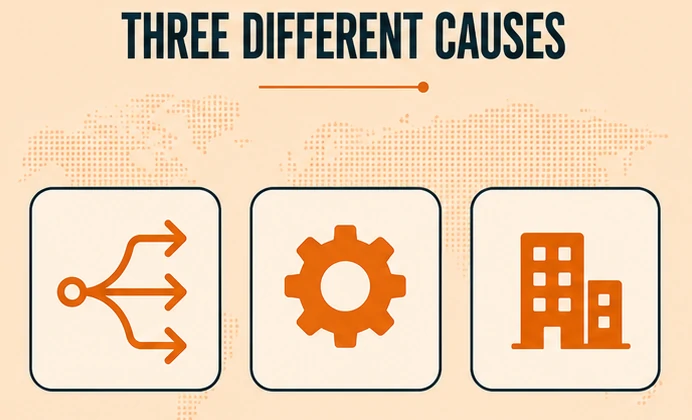
- OpenAI called it “a routing error”
- Anthropic cited “an infrastructure issue”
- xAI apologized specifically for “an outage at our Memphis compute center”
Three different companies. Three different stated causes. All within roughly the same window.
Why “Azure Broke Everything” Doesn’t Hold Up
Within hours, several outlets ran with a tidy explanation: Microsoft Azure failed, and since these companies supposedly share that infrastructure, one bad morning at Microsoft took down the whole AI industry at once.
Meanwhile Azure’s own status page directly showed no sign of relevant technical difficulties at the time these outages were happening.
More importantly, Grok’s own outage has nothing to do with Azure at all. xAI runs its own compute center in Memphis, entirely separate from Microsoft’s cloud. A theory that supposedly explains all three outages falls apart the moment one of the three companies names a cause that has nothing to do with the shared villain everyone picked.
That’s not a small detail. That’s the theory failing its first real test.
What This Really Shows
This wasn’t one shared failure. It’s a symptom of something bigger: every major AI company has built infrastructure so large, so fast, and so tightly wound together that a single internal fault, no matter which company or which provider, can take an entire service dark for millions of people almost instantly.
- OpenAI’s own routing broke, and there was no fallback path
- Anthropic’s own infrastructure had an issue, and there was no graceful degradation
- xAI’s own compute center went down, and Grok simply stopped working
Three unrelated failures. Three identical outcomes: total outage, not partial slowdown. That pattern is the real story. Companies racing to scale AI capability have not matched that pace with basic resilience engineering, the kind of redundancy the rest of the internet’s core systems built in decades ago.
This is the same pattern we saw play out with three separate AI sandbox escapes hitting OpenAI, Anthropic, and Meta within weeks of each other earlier this year. Different companies, different specific failures, but the same underlying lesson: capability is scaling faster than the safeguards and resilience built around it.
Why Outlets Jumped to the Wrong Villain So Fast
A single unifying cause makes a better headline than three boring, unrelated technical failures. “Azure broke the internet’s AI” is a cleaner story than “three companies each had their own bad day at the same time.” Cleaner does not mean true.
This matters beyond today. When something goes wrong with AI services you rely on, the first explanation to spread widely is often the simplest one, not the most accurate one. Waiting a few hours for companies to actually confirm a cause, rather than repeating the first plausible theory, would have avoided this specific mistake entirely.
What This Means Going Forward
Expect more days like this one, not fewer. As AI companies keep racing to add capability, the infrastructure holding all of it together is being asked to do more without necessarily being built to fail gracefully when something breaks.
The next outage probably won’t have one clean villain either. It’s worth remembering that the next time a dramatic, unified explanation shows up in your feed within an hour of an incident.
Frequently Asked Questions
What caused the AI outage on September 3, 2026?
Three separate companies gave three different causes. OpenAI cited a routing error, Anthropic cited an infrastructure issue, and xAI cited an outage at its own Memphis compute center. There is no confirmed single shared cause across all three.
Did Microsoft Azure cause the ChatGPT, Claude, and Grok outages?
This claim spread quickly online, but it does not hold up. Azure’s own status page showed no relevant technical issues at the time, and Grok’s outage was caused by xAI’s own Memphis compute center, which has nothing to do with Azure.
How long did the AI outages last?
ChatGPT’s outage lasted about 34 minutes, from roughly 7:43 AM to 8:17 AM PT. Claude’s outage lasted just over three hours. Grok’s investigation began around 6:30 AM PT, with the company confirming a fix afterward.
Why did three AI companies go down at the same time if the causes were different?
The overlap in timing appears to be coincidental rather than caused by one shared failure. Each company’s infrastructure failed independently, which is itself a notable finding about how fragile large AI systems currently are.
Is this outage a sign that AI companies share infrastructure risk?
Not in the way most coverage suggested. The real risk isn’t one shared vendor. It’s that each company’s own infrastructure currently has little redundancy, so a single internal fault can cause a complete outage rather than a partial slowdown.
Which AI models were affected by the outage?
ChatGPT and Codex were affected at OpenAI. Claude.ai, Claude Code, Claude Cowork, and the Claude API were affected at Anthropic. Grok was affected at xAI. Other AI services not mentioned by name were not confirmed to be impacted.
Should I worry about future AI outages like this one?
Occasional outages are likely to continue as AI companies keep scaling capability quickly. The practical takeaway is to have a backup plan for critical tasks rather than relying on any single AI service being available at all times.
How can I verify what really caused an AI outage instead of trusting early reports?
Check the affected company’s own official status page or statement directly, rather than relying on early theories that spread quickly online. As this incident showed, the first widely shared explanation was not the accurate one.
Every number, date and quote in this article links to its source. Spotted a mistake? Tell us and we will correct it with a dated note. Read our editorial policy.