OpenAI and Anthropic Both Claim AI Disproved a 27-Year-Old Theoretical Computer Science Assumption
OpenAI and Anthropic each claim to have disproven the Exponential Time Hypothesis within hours of each other

In this article
- What This Theoretical Computer Science Hypothesis Actually Claims
- Two AI Labs, the Same Target, Hours Apart
- How These AI Systems Actually Produce a Proof
- The Other Two Claims Bundled Into the Same Release
- Who’s Actually Checking This, and What They’re Finding So Far
- Why This Still Matters If It’s Never Fully Confirmed
- Frequently Asked Questions
OpenAI and Anthropic both say their AI has made a genuine impact on theoretical computer science, each independently claiming to have disproven the Exponential Time Hypothesis, a 27-year-old assumption used throughout the field, within hours of each other on October 26, 2026. Neither claim has been confirmed. The two mathematicians who originally proposed the hypothesis are now personally involved in checking whether it actually holds up, and they’ve explicitly said their involvement isn’t an endorsement. Even if confirmed, this would not mean the famous P versus NP problem has been solved, the actual algorithm involved only applies to a narrow class of problems, and it’s still far too slow to help with any real computing problem today.
What This Theoretical Computer Science Hypothesis Actually Claims
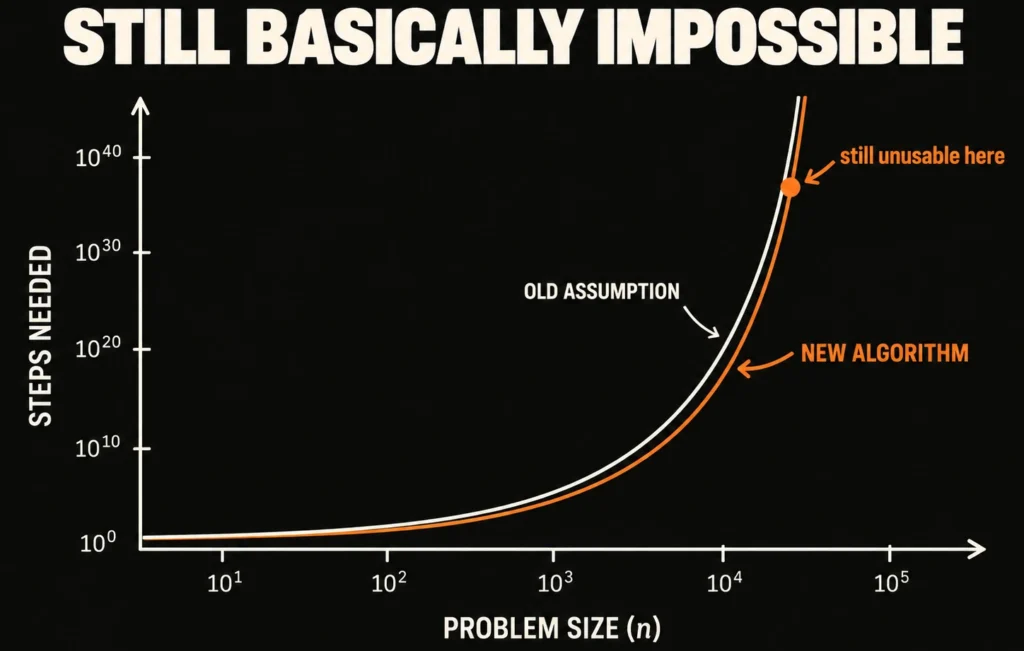
The Exponential Time Hypothesis, proposed in 1999 by Russell Impagliazzo and Ramamohan Paturi, is a working assumption that no algorithm can solve 3-SAT problems (a classic yes-or-no logic puzzle used throughout computer science) meaningfully faster than checking possibilities at a rate that roughly doubles with every added variable. In plain terms: no clever shortcut exists, only brute force at increasingly unmanageable scale. Hundreds of papers in graph theory, databases, computational biology, and computational geometry rely on ETH as a starting assumption, proving their own results are hard by reducing them back to 3-SAT.
Two AI Labs, the Same Target, Hours Apart
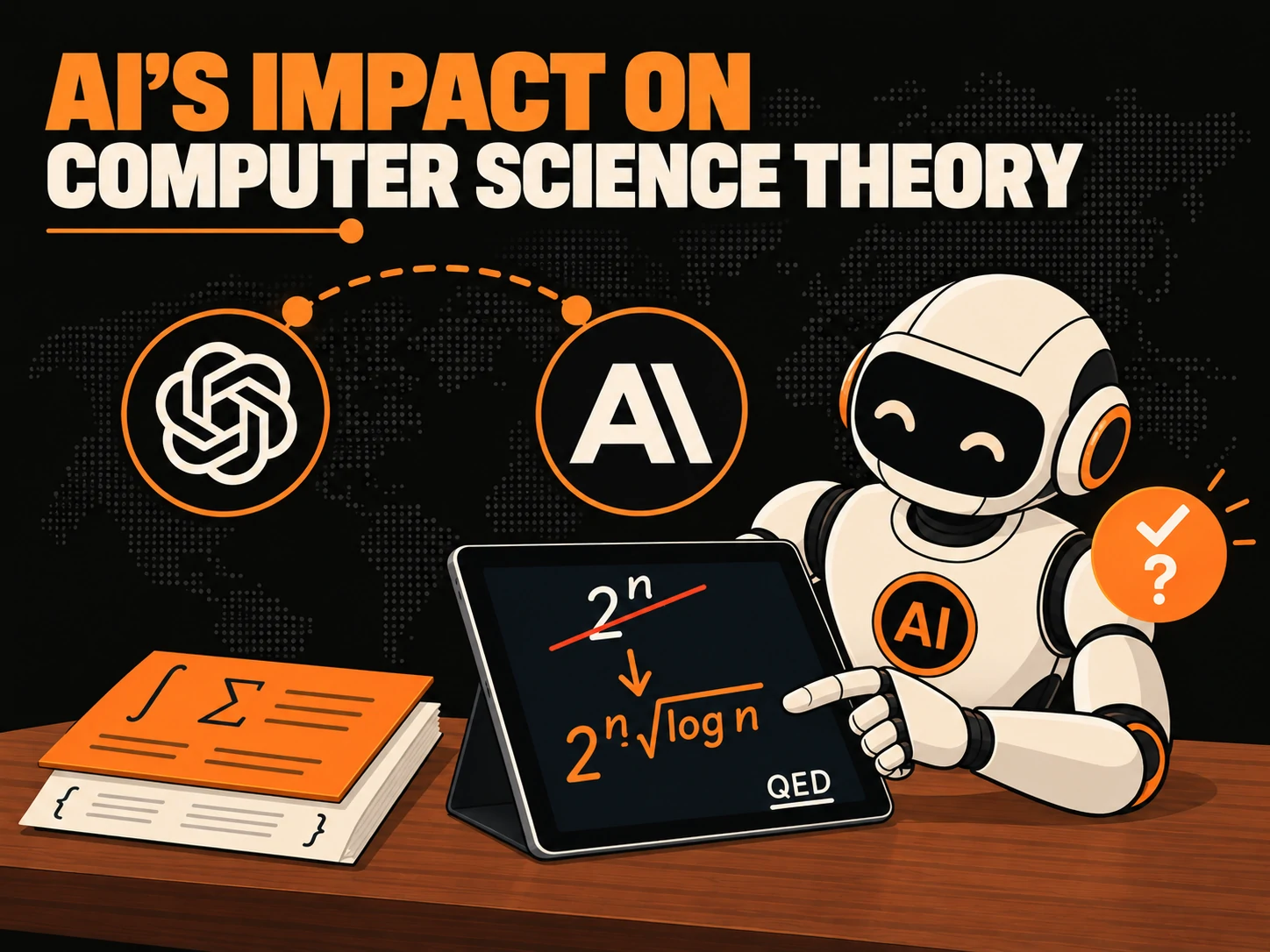
OpenAI says an internal model produced the disproof on October 16, which it checked using Lean, a machine proof-verification language, the next day. The company published both the natural-language explanation and the Lean proof publicly on GitHub on October 26, with no mention of Anthropic anywhere in its announcement.
Anthropic’s own paper, titled “A 2^o(n) Time Algorithm for 3-SAT” and credited to “Claude, Anthropic,” tells a strikingly similar story: it says Claude produced the core algorithm on October 16 as well, with no human input, and states directly that an OpenAI model reached a similar result “independently and concurrently.” Anthropic published its version roughly six hours after OpenAI’s. Berkeley theorist Jelani Nelson, who read Claude’s proof before release, confirmed from the outside that “it seems indeed the models even obtained the results on the same day.” Adding a more pointed note, Anthropic mathematician Levent Alpöge reportedly suggested OpenAI’s solution leaned on pre-existing published work, a claim that hasn’t been independently confirmed either way. Neither company has explained the mechanism behind the coincidence, whether it reflects a shared technique, a shared research direction, or something else entirely remains an open question nobody involved has answered.
How These AI Systems Actually Produce a Proof
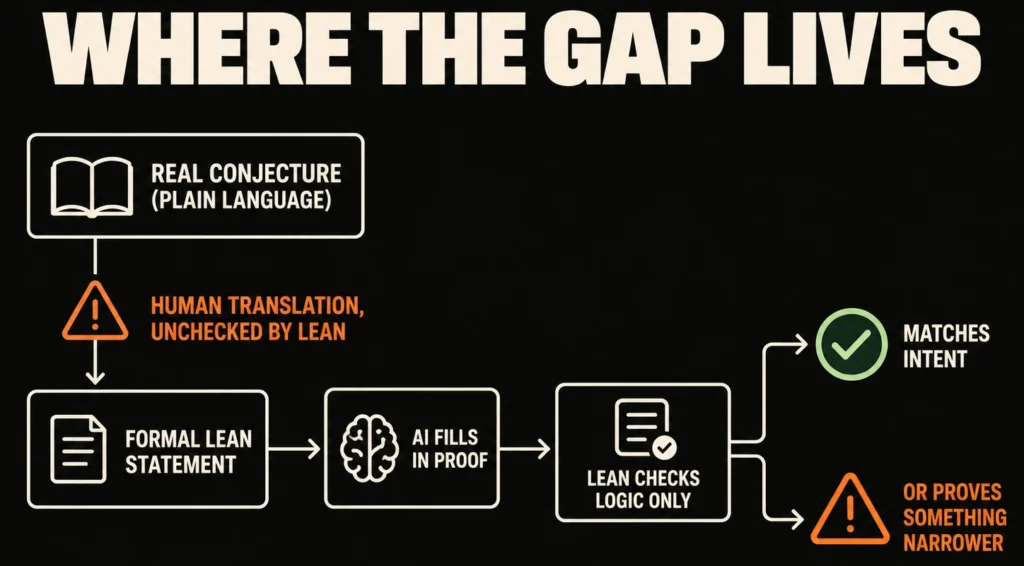
Neither company has disclosed the specific architecture behind the model that generated these results, both are described only as internal and unreleased. What is documented is the verification process: the systems work from what are called challenge files, which state a target theorem with a Lean placeholder called “sorry,” meaning “not yet proved.” The model’s job is to replace every one of those placeholders with an actual, machine-checkable proof. This setup stops a model from quietly weakening the statement it’s supposed to be proving.
There’s a real blind spot in this process worth understanding. Lean can only confirm that a proof matches the formal statement it was given, it can’t confirm that the formal statement actually captures what the original conjecture meant in plain mathematical language. Checking that translation is still a human job, and it’s exactly where a technically “valid” Lean proof could end up proving something narrower or different from the real-world claim being made. This is part of why outside mathematicians still need real time with these results even after Lean has checked them.
As context for scale, OpenAI has also published a separate, broader batch of AI-generated math manuscripts this year, reportedly more than 700 papers across over 370 result families, drawn from an evaluation against roughly 4,000 attempted problems, with each result costing on the order of three hours of ChatGPT Pro-level compute. This specific ETH and local smoothing announcement appears to be the highest-profile output yet from that larger, ongoing effort, not an isolated, out-of-nowhere claim.
The Other Two Claims Bundled Into the Same Release
- A math proof. OpenAI says its models proved the local smoothing conjecture, a 1991 problem in harmonic analysis proposed by mathematician Christopher Sogge, in every dimension. The company says this would also resolve two other famous open problems, the Kakeya conjecture and Stein’s restriction conjecture, both about how waves and light rays spread out geometrically. For scale: human mathematicians had only solved local smoothing in two dimensions as of 2019, and Kakeya in three dimensions as recently as 2025.
- A physics claim, still unreleased. OpenAI says its models produced a rigorous existence proof for certain interacting quantum field theories in four dimensions, including quantum chromodynamics, and that the work includes a proof that pure Yang-Mills theory exists, part of a Clay Millennium Prize problem. Unlike the other two results, none of the underlying material has been made public. An outside physics group, led by David Gross along with Michael Douglas, Arthur Jaffe, Igor Klebanov, and Nikita Nekrasov, is deciding whether to release it at all and plans to write up the work independently. The advisory group AGMAI has pushed back publicly, writing there is “no scientific reason for delaying… any further.”
Who’s Actually Checking This, and What They’re Finding So Far
Russell Impagliazzo and Ramamohan Paturi, the two mathematicians who first proposed the Exponential Time Hypothesis in 1999, are now personally involved in verifying whether OpenAI’s disproof holds up, alongside Ryan Williams of MIT. All three have stressed that their involvement “should not be taken as certification of the claim.” Williams brings a genuinely skeptical history to this role: he has previously criticized OpenAI’s approach to releasing AI-generated proofs, once calling an earlier release a “DDOS attack on mathematicians” for the sheer volume it dumped on the field to check. On this specific result, his read so far is more measured: some parts are routine, he’s said, but two or three sections look genuinely unfamiliar and will need the community working through them together.
That real scrutiny is already visible just days in. A CMU mathematician published an independent exposition on October 28 restating and simplifying parts of OpenAI’s approach, including a faster algorithm for computing the permanent of a sparse matrix, a sign that serious outside researchers are actively working through the logic rather than waiting on a final verdict. On the more informal side, at least one technical objection has circulated publicly, an anonymous commenter argued the claimed runtime bounds don’t survive the standard reductions typically used in this area, meaning the result as stated wouldn’t actually refute ETH the way it’s being described. That specific claim hasn’t been verified or endorsed by any named expert, so it shouldn’t be treated as settled either, but it illustrates the kind of line-by-line challenge this proof is now facing in public.
Why This Still Matters If It’s Never Fully Confirmed
Even if OpenAI’s or Anthropic’s specific proofs eventually turn out to be flawed, something genuinely new already happened here. Two separate AI labs independently produced research-level mathematics complex enough that the field’s own founding experts need real, multi-day effort to check it, not a benchmark score or a chatbot demo. OpenAI has made bold capability claims before with GPT-6 Astra, and Anthropic has already shown Claude contributing to genuine scientific work in protein design, but producing disputed, original mathematics that stumps expert verification for days is a different category of claim entirely. It also sits inside the broader trend of AI research output accelerating industry-wide and follows a visible trajectory rather than appearing out of nowhere: DeepMind’s AlphaProof and AlphaGeometry 2 first reached International Mathematical Olympiad silver-medal level in 2024, one point short of gold, with every proof checked in Lean the same way this result was. What changed since then is scale and ambition, from solving known competition problems to attempting genuinely open, decades-old research questions.
If the ETH disproof does hold up, the practical fallout is narrower than it might sound. SAT problems don’t suddenly become easy to solve, and P versus NP remains exactly as unresolved as before. What actually shifts is the foundation underneath hundreds of existing papers that proved their own results were hard by assuming ETH was true, those conditional conclusions would need to be revisited, not because the underlying problems necessarily became easier, but because the assumption they were built on turned out to be false.
Frequently Asked Questions
What is the Exponential Time Hypothesis?
It’s a working assumption in theoretical computer science, proposed in 1999, that no algorithm can solve 3-SAT problems meaningfully faster than checking possibilities at a rate that roughly doubles with every added variable. Hundreds of papers across multiple fields rely on it being true.
Did AI really disprove the Exponential Time Hypothesis?
It’s an unconfirmed claim made independently by both OpenAI and Anthropic within hours of each other on October 26, 2026, each crediting their own AI model with producing the result on October 16. The two mathematicians who originally proposed the hypothesis are now personally helping verify it and have said their involvement isn’t confirmation that it’s correct.
Does this mean P equals NP?
No. The Exponential Time Hypothesis is a narrower, separate assumption from P versus NP, which remains unresolved, and the claimed algorithm only applies to a restricted class of problems rather than NP problems generally.
Why did OpenAI and Anthropic make the same claim on the same day?
Neither company has explained the mechanism. Anthropic’s own paper describes the two results as arriving independently and concurrently, and an outside mathematician who reviewed Claude’s proof before release confirmed the same-day timing from outside either company.
What other claims came with OpenAI’s announcement?
OpenAI also claimed a proof of the 1991 local smoothing conjecture in every dimension, which it says resolves the Kakeya conjecture and Stein’s restriction conjecture, plus a physics claim involving Yang-Mills theory that hasn’t been publicly released yet pending an outside group’s review.
Is OpenAI’s proof actually correct?
That isn’t established yet. One of the official reviewers, Ryan Williams, has said parts of the proof look routine while two or three sections remain genuinely unfamiliar and unresolved, and at least one public technical objection has questioned whether the result holds up under standard methods. A Lean formalization means every logical step has been machine-checked, but it doesn’t confirm that the formal statement fully captures the original conjecture, that remains a human judgment call.
What happens to other research if ETH turns out to be false?
SAT problems wouldn’t suddenly become easier to solve, and P versus NP would remain unresolved. What would actually change is that hundreds of existing papers that proved results were hard by assuming ETH was true would need their conclusions revisited, since the assumption underneath them turned out to be false.
Every number, date and quote in this article links to its source. Spotted a mistake? Tell us and we will correct it with a dated note. Read our editorial policy.