Got Falsely Accused Of Using AI? Here’s What To Do
AI cheating detection falsely flags 61 percent of non-native English writers, and two 2026 lawsuits are now challenging schools over it.

In this article
- What Happened: AI Cheating Detection Is Flagging the Wrong Students
- Why AI Detector Bias Keeps Flagging the Wrong Students
- What Matters: Why Schools Keep Using a Tool Even Its Own Maker Calls Unreliable
- How to Prevent False AI Cheating Accusations Before You Submit
- What to Do If You’re Already Flagged by an AI Detector
- Frequently Asked Questions
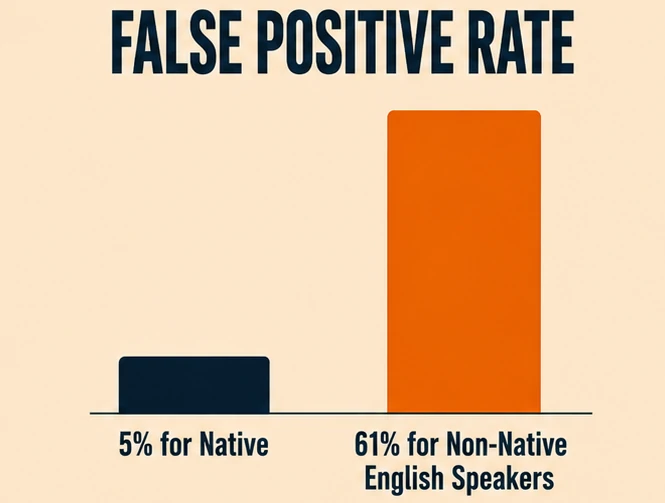
AI cheating detection just cost a Palo Alto teenager his grade, and it may not stop there. Schools now run millions of student essays through tools built to catch AI writing. However, those same tools misfire on real students every single day. One study found a 61.2 percent false positive rate for non-native English writers. Native speakers scored just 5.1 percent on the same test. If your child, or you, sound a little too simple on paper, that gap could turn into a real accusation.
What Happened: AI Cheating Detection Is Flagging the Wrong Students
AI cheating detection tools promise a simple answer to a hard question. They scan a student’s writing and hand back a percentage score. Teachers then treat that score as proof, even though the tools themselves warn against that use. Two recent cases show exactly how that trust can go wrong.
The Palo Alto Lawsuit That Put AI Detection on Trial
A Palo Alto High School sophomore wrote an essay on The Crucible in October 2025. Turnitin’s AI detector flagged the essay as 76 percent likely AI generated. His family gathered 1,162 pages of evidence showing he wrote it himself. The school held the grade anyway. On May 11, 2026, the family filed a federal civil rights lawsuit against the district.
- Essay flagged at 76 percent likely AI generated
- Family submitted more than 1,100 pages of drafts and evidence
- The grade was not restored before the lawsuit was filed
- The case now argues the district skipped due process entirely
Adelphi University’s Case Shows the Same Pattern
Orion Newby, an Adelphi University freshman on the autism spectrum, faced a similar accusation. A history professor cited a Turnitin score of 100 percent AI generated. However, the court later found no supporting documentation existed for that score. Newby said he only received grammar help from a campus tutoring program. On January 29, 2026, a Nassau County judge sided with Newby completely. The court ordered Adelphi to expunge the violation from his academic record.
Why AI Detector Bias Keeps Flagging the Wrong Students
The bias here traces back to a well documented 2023 study. Researchers ran seven AI detectors against real essays from TOEFL test takers. Every single essay was written entirely by a human. Yet the detectors flagged 61.2 percent of non-native writers as AI generated. Native speaker essays triggered almost no false alarms at all, a gap The Markup’s reporting later confirmed held up outside the lab too.
Students most likely to get flagged tend to share a few traits:
- Non-native English speakers, who often write in simpler, more predictable patterns
- Neurodivergent students, including students on the autism spectrum
- Students who write short, direct sentences instead of varied ones
- Students who lean on grammar tools before submitting a draft
This happens because AI detectors measure predictability, not honesty. Large language models learned from simplified, grammatically careful writing. As a result, any human who writes that way risks the same flag, fairly or not.
What Matters: Why Schools Keep Using a Tool Even Its Own Maker Calls Unreliable
Turnitin has said publicly that its AI score should never stand alone as proof. Even so, individual teachers keep treating a single number as a verdict. We think that gap, between the tool’s own warning label and how it actually gets used in real classrooms, is the real scandal here, not the software itself.
Several schools have already responded by pulling the feature entirely:
- The University of Arizona turned off Turnitin’s AI detection over reliability and equity concerns
- Curtin University in Australia is disabling its AI detector in 2026
- Multiple other campuses have quietly made the same call
Meanwhile, plenty of districts and colleges kept the feature switched on. Because of that split decision, where a student happens to go to school can decide whether a plain sentence turns into a formal accusation, a pattern that fits a wider shift in how AI is already reshaping daily life for younger students.
How to Prevent False AI Cheating Accusations Before You Submit
You cannot control which detector your school uses. You can control how much proof you leave behind.
- Write and edit inside Google Docs or Microsoft Word, never paste a finished draft in one block
- Turn on version history before you start typing, not after you finish
- Keep photos of handwritten notes, outlines, and brainstorming pages
- Save links or screenshots of any source you researched along the way
- Ask your teacher what score triggers a review, before you turn anything in
- Avoid heavy AI powered rewrite features inside grammar tools, since some blend AI phrasing into your own draft
None of these steps take more than a few extra minutes. Still, that small habit is exactly what separated Newby’s case from a routine accusation once it reached a judge.
What to Do If You’re Already Flagged by an AI Detector
Do not panic, and do not accept the score as final. A detector result is a starting point, not a verdict, based on how both of these lawsuits played out.
- Ask to see the exact tool, score, and threshold used against you
- Request a human review before any grade or discipline becomes final
- Submit your version history, notes, and outlines as evidence
- Point to the Adelphi ruling if your school treats a bare score as proof on its own
- Ask in writing whether the school’s policy allows a formal appeal
AI cheating detection was supposed to protect academic honesty. Instead, it is producing lawsuits, overturned rulings, and real harm to students who never touched AI at all. Two families already fought back and won meaningful ground. The next flagged student should not have to start from zero.
Frequently Asked Questions
Can you be falsely accused of using AI?
Yes. AI detectors regularly misread human writing as AI generated, especially from non-native English speakers and neurodivergent students. The Palo Alto and Adelphi cases both show real students punished before any human review caught the error.
Is 40% AI detection bad?
It depends on your school’s policy, but many institutions treat any score above zero as a red flag. Turnitin itself has warned that a score, at any level, should never stand alone as proof of cheating. Independent testing has found human written papers scoring well above that range far more often than expected.
How can I prove I didn’t use AI?
Version history from Google Docs or Microsoft Word is the strongest evidence, since it shows gradual edits over time. Handwritten notes, outlines, and research screenshots also help support your case.
Can professors prove you used AI?
Not with a detector score alone. The Adelphi University ruling showed a judge rejecting a case built only on an AI percentage, since no documentation existed behind the score used against the student.
How to avoid AI accusations?
Write inside Google Docs or Word with version history turned on from the start. Keep your outlines, notes, and research sources as you go, and ask your teacher what score triggers a review before you submit anything.
What to do if a teacher accuses you of AI?
Stay calm and ask to see the exact tool, score, and threshold used against you. Request a human review and submit your version history, notes, and drafts as evidence before accepting any penalty.
How can I humanize my text?
AI humanizer tools rewrite generated text to sound more natural by varying sentence length and swapping common phrasing. That said, using one to disguise text you did not actually write raises the same honesty problem this article is trying to help students avoid, not solve.
How accurate are AI humanizers?
Not very reliable. Many “humanized” texts still get flagged by newer detectors, since the underlying word patterns often remain detectable underneath the rewrite. Leaning on a humanizer instead of your own original draft also leaves you with no genuine version history if a school ever asks for one.
How can I check if a text is AI-generated?
No single detector is fully reliable, since false positive rates vary widely by tool and by writer. A document’s edit history is a far more consistent signal than any detector’s percentage score, since real writing tends to show gradual changes over time.
How common are false positive AI detections?
More common than most people realize. One widely cited study found a 61.2 percent false positive rate for non-native English writers, compared to just 5.1 percent for native speakers, a gap that pushed several universities to disable AI detection entirely.
Every number, date and quote in this article links to its source. Spotted a mistake? Tell us and we will correct it with a dated note. Read our editorial policy.